



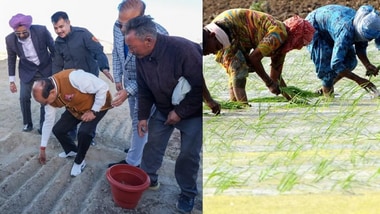
The high-altitude cold desert of Ladakh is witnessing a large-scale experiment in saffron cultivation, as the Union Territory administration looks to turn previously barren land into productive farmland and explore new sources of income for local communities, according to news agency PTI.
Around 800 kg of premium Iranian saffron corms, numbering nearly 90,000, have been planted across 4,000 square metres at Spituk Pharka in Leh, Lieutenant Governor Vinai Kumar Saxena said on Friday.
The cultivation is taking place on land restored under Project Him Sarovar, a government initiative focused on improving water availability and bringing degraded land back into agricultural use in the mountainous region.
“I am pleased to announce an ambitious experiment of introducing saffron cultivation to Ladakh, for the very first time, on a large scale,” Saxena said in a post on X.
The administration hopes the high-value crop could help expand the region’s agricultural options and generate additional livelihood opportunities for farmers, young people and self-help groups.
According to Saxena, the Iranian saffron corms were chosen after considering their ability to adapt to Ladakh’s high-altitude agro-climatic conditions.
The experiment follows nearly two years of efforts by the Ladakh administration and scientific institutions to determine whether saffron can be grown successfully in the region.
Trials for saffron cultivation in Ladakh have already been underway. In March 2025, the administration said the Council of Scientific and Industrial Research-Indian Institute of Integrative Medicine (CSIR-IIIM) was conducting cultivation trials in the region.
The administration had also proposed working with CSIR-IIIM to examine whether saffron cultivation could be economically viable and determine which varieties would be best suited to Ladakh’s local conditions.
Kargil has emerged as another potential location for the crop. In September 2025, the Agriculture Department, along with CSIR-IIIM, provided saffron corms to progressive farmers in the district and conducted training programmes covering scientific cultivation and post-harvest practices.
The Leh experiment is part of a wider effort to make agriculture more viable in an area where farming is challenged by limited rainfall, a short cultivation window and extreme weather conditions.
Launched in April, Project Him Sarovar aims to conserve water from snowfall and glacial melt by developing water bodies that can support irrigation and strengthen long-term water security.
A water body constructed at Spituk Pharka was inaugurated in June at an altitude of about 11,500 feet. The administration said the project would help provide irrigation and enable agricultural activity on land that had remained barren.
If the experiment proves successful, saffron could become another high-value agricultural crop for Ladakh, while supporting the administration’s efforts to diversify farming and create new livelihood opportunities.