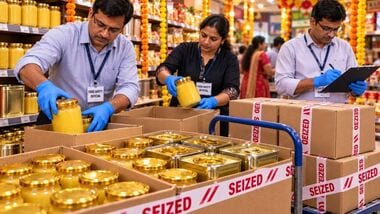
During the , shoppers tend to splurge more, drawn by a host of offers and steep discounts. However, not every deal is a good bargain. In a statement on Friday, Delhi Chief Minister Rekha Gupta announced that the capital’s food safety department had seized over 322 kg of ghee amid concerns over quality and pricing.
The inspections targeted stores promoting deals on social media, including ‘Buy One, Get One Free’ offers and discounts of up to 60 per cent. According to PTI, officials inspected the shops to assess compliance with food safety rules and check for adulterated, substandard, expired, or incorrectly labelled products.
During inspections at Maxcart Store and Aggarwal Store in west Delhi’s Vikaspuri, officials collected five enforcement samples of from several brands, along with samples of other food products. Over 75.5 litres of ghee were seized.
Similarly, at Aggarwal Store in Hastal village, officials collected three enforcement samples of ghee from the Shri Shan, Vrinda Farms and Avtar brands and seized 246 kg of the product.
In separate inspections, the department also collected samples of other food items, including two samples of sugar-boiled confectionery from a store called Sahib Sons in Azad Market, which was operating under the trade name Vicon International. The samples were collected over suspected labelling irregularities.
Additionally, samples of makhana and powder were collected from Jain Store in Lajpat Nagar, while samples of different types of biscuits, soft candy and sugar-based candy were collected from Yug Basket Private Limited in Rithala.
The food safety department stated that the findings would be assessed alongside laboratory test reports before any further action was taken. It added that inspections had revealed lapses in adherence to food safety standards at the establishments and that further action would follow.
The development comes days after the food safety department carried out an inspection drive last week and found several samples unfit for consumption. According to reports, the department found that 19 of 59 desi ghee samples were unfit for consumption, while four others were substandard. Samples from different brands were collected from markets across the capital, including Naharpur, Posangipur, Laxmi Nagar, Preet Vihar, Rampura, Tagore Garden, Kalyanpuri, Krishna Vihar and Kondli.
Separately, frozen green peas, Greek yoghurt, soft drinks and eggless chocolate-chip brownies were among the items found stocked for sale at warehouses and dark stores despite being past their use-by dates.
Following the inspection drive, Gupta said in a statement, “The food safety department has been directed to tighten monitoring of markets, food storage facilities and establishments supplying food products through online platforms. Action must be taken in accordance with the rules wherever food safety standards are violated. The govt’s objective is not merely to identify deficiencies, but also to ensure a system in which every family in Delhi has access to safe and quality food. Protecting public health and ensuring accountability in the food trade remain govt priorities.”
Following the seizure of over 322 kg of ghee, Rekha Gupta on Friday urged consumers to check the quality and packaging of food products, along with their manufacturing and expiry dates, before purchasing them.
The Food Safety and Standards Authority of India () has outlined a home test to detect starch adulteration in ghee. Place half a teaspoon of ghee in a clear glass bowl and add two to three drops of iodine solution. A blue colour may indicate the presence of starch, potentially from mashed potato or sweet potato. However, the absence of a colour change does not establish that the ghee is pure or free from other adulterants.
(with agency inputs)