



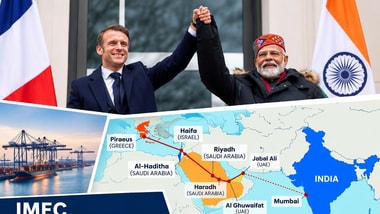
The India-Middle East-Europe Economic Corridor (IMEC) cannot be directly compared with China’s Belt and Road Initiative (BRI) when it comes to financing, France’s IMEC envoy, Gérard Mestrallet, underlining the fundamentally different models through which the two connectivity projects are being developed.
“The concept is very different. And so we cannot compare the competitiveness of the financing of the BRI and of IMEC,” Mestrallet, Special Envoy of the French President for IMEC, told LiveMint during a press conference hosted by the French Embassy at ITC Maurya in New Delhi on Tuesday.
“For the BRI, there is one which finances the project. Depending on the country, depending on the nature of the sector, we will gather different groups,” he said.
Mestrallet was in New Delhi for the launch of the IMEC Ports Club alongside Christophe Castaner, Chairman of the Port of Marseille-Fos.
The comments come amid renewed focus on as geopolitical tensions and disruptions in West Asia raise questions over the resilience of existing trade routes and the need for alternative connectivity corridors.
Unlike China’s BRI, which Chinese state-linked financing institutions have historically backed, is being developed as a partnership involving multiple countries, institutions and private-sector players across its proposed route.
Mestrallet said the two projects therefore operate on fundamentally different financing concepts, making a direct comparison of their competitiveness difficult.
His remarks also come at a time when IMEC is being discussed not merely as an infrastructure project but as a potential strategic alternative to strengthen trade and connectivity among India, the Middle East and Europe.
The ongoing crises in the , including the Gaza war, tensions involving Iran and disruption risks around the Strait of Hormuz, have made IMEC more necessary, according to Mestrallet.
“The difficulties — 7 October, , Iran, Hormuz — have even increased the necessity to have a resilient corridor, offering several possibilities to the market,” Mestrallet said during the event.
According to the French envoy, should increasingly be viewed not as a single, fixed route but as a network of complementary routes that can provide alternatives when one route is disrupted.
“IMEC is now considered a network of complementary routes in order to be more resilient. More resilient, meaning that if on one particular route there is a blockage, an accident, a technical problem or even a local crisis, the other routes will be available,” he said.
has returned to the centre of discussions as countries navigate the latest crisis in West Asia and the risks to shipping through critical maritime routes.
Amid the escalating conflict in West Asia, the proposed India-Middle East-Europe trade corridor is being viewed as a potential way to diversify connectivity and reduce dependence on vulnerable chokepoints.
US President has also renewed Washington’s support after backing the proposed trade network, which is intended to strengthen connectivity between India, the Middle East and Europe.
Mestrallet said should not be viewed merely as an infrastructure or economic initiative, arguing that the corridor also has a broader geopolitical objective.
“We consider this project not only as a technical project or an economic project, but also as a geostrategic project, in order to strengthen the links between India and ,” he said.
The French envoy said the current geopolitical environment has strengthened the case for building alternative and resilient connectivity routes.
At the same time, he stressed that the market would ultimately determine which routes are used, with cost, speed and infrastructure performance continuing to shape commercial decisions.
The growing risks around the could also change the economics of global trade routes, Mestrallet said.
“Sometimes it will be cheaper, more competitive to take a longer route, but a safer route,” he added.