


Brazil’s presidential election could have consequences far beyond the country’s domestic politics. A victory for Flávio Bolsonaro on 25 October would put Latin America’s largest economy under a government more closely aligned with US President Donald Trump, potentially giving Washington a new partner in a region where security, trade and competition with China are becoming increasingly intertwined.
The stakes are unusually high because Brazil is not simply another country moving towards Washington. It accounts for about 31% of Latin America’s gross domestic product, making it the region’s largest economy, and plays an influential role in BRICS, Mercosur and the wider Global South.
Trump has built relationships with governments across Latin America that vary considerably in their political outlook and their closeness to Washington.
Argentina’s Javier Milei has emerged as one of Trump’s most openly aligned regional partners. El Salvador’s Nayib Bukele has worked closely with Washington on migration and security, while Ecuador’s Daniel Noboa has expanded security cooperation with the US.
Chile’s José Antonio Kast has also joined the Trump-backed Shield of the Americas framework. Colombia, Honduras, Peru and Bolivia have likewise moved closer to Washington to varying degrees.
But Brazil is in a different category because of the size of its economy and its diplomatic weight.
Brazil is also a major trading partner of China and a prominent member of BRICS. Its relationship with Beijing gives Brasilia an importance in US-China competition that smaller Latin American economies do not possess.
The emerging US strategy in the Latin American region extends beyond elections and political alliances. The Shield of the Americas framework brings together the US with Argentina, Bolivia, Chile, Colombia, Costa Rica, the Dominican Republic, Ecuador, El Salvador, Guyana, Honduras, Panama, Paraguay, Peru and Trinidad and Tobago.
Its agenda includes security cooperation, economic ties and multilateral coordination. The framework also addresses areas such as critical-mineral supply chains, investment screening and digital infrastructure.
That gives Washington several points of engagement with governments across the region, from combating organised crime to securing strategic resources.
If Flávio Bolsonaro wins, Brazil could become one of the most consequential additions to the US’s expanding network of regional partnerships.
The potential shift would involve more than political symbolism. Brazil’s size gives it influence over regional trade, critical resources, energy, food supplies and diplomatic groupings that matter beyond the Western Hemisphere.
It could also affect the balance between Washington and Beijing in a region where China has become an important economic partner.
For the US, closer ties with Brazil could therefore open opportunities across trade, critical minerals, technology and security.
For Brazil, the relationship would involve its own calculations. The country has historically sought room to maintain relationships with competing global powers, including the US and China, rather than aligning completely with one side.
Brazil’s economic scale sets it apart from most of the countries that have recently moved closer to Washington. Its GDP was about $2.28 trillion in 2025, according to World Bank data.
That was larger than Mexico’s $1.83 trillion economy and more than three times the size of Argentina’s $683 billion economy. Brazil’s GDP was also roughly six times that of Colombia and more than seven times that of Chile.
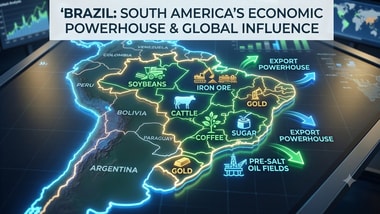
That economic weight comes with an unusually broad resource base. Brazil is a major producer and exporter of soybeans, beef and iron ore, while its offshore oil industry has turned it into an important energy producer. Its mineral wealth is particularly significant.
In 2024, Brazil accounted for 93% of global niobium production and about 17% of global iron ore production, according to the US Geological Survey. It was also among the world’s leading producers of bauxite, graphite, lithium, manganese and tantalum. U.S. Geological Survey
The country’s importance to global supply chains extends beyond its mines. Brazil is one of the world’s major agricultural producers, with vast areas devoted to soybeans and other crops, and its offshore oil reserves add another source of strategic value.
Then there is the Amazon. Brazil contains roughly two-thirds of the Amazon rainforest, giving it an unusual role in global discussions over climate policy, carbon markets, agriculture and environmental protection.
The numbers help explain why Brazil would represent something different for Washington. Mexico and Brazil are the two economic giants of Latin America, but Brazil combines a $2.28 trillion domestic economy with agricultural exports, oil, iron ore and critical minerals, while maintaining deep commercial ties with China.
That means a shift in Brasilia’s foreign policy would have implications not only for regional politics, but also for energy, food, minerals, trade and the US-China competition over strategic supply chains.
A Bolsonaro victory would therefore bring into Washington’s orbit a country whose economic and resource base is considerably larger than that of most of the governments that have recently aligned themselves more closely with the US.