



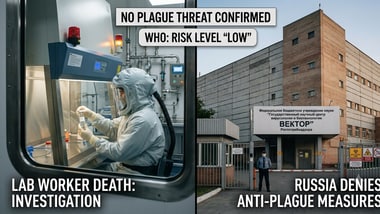
Russian authorities have denied reports that they imposed special anti-plague measures after a laboratory worker in the Siberian region of Irkutsk died of pneumonia, amid reports that she may have contracted pneumonic plague.
The case has drawn international attention, with the World Health Organization (WHO) saying the public health risk is currently low for Russia and very low for the rest of Europe. The UN health agency is nevertheless monitoring the situation and seeking to verify the circumstances surrounding the woman’s death and laboratory test results.
US Secretary of State Marco Rubio has also called on Moscow to be more transparent about the case.
A 28-year-old woman, identified by Russian media as Darya Shipilova, reportedly worked at the Irkutsk Anti-Plague Research Institute of Siberia and the Far East, a facility that studies dangerous pathogens, including plague.
She died last week at a hospital in Shelekhov, a town near Irkutsk.
Reports by Russian news outlet People of Baikal said she may have contracted pneumonic plague after a test tube broke at the laboratory.
However, Russian authorities have not confirmed that she had plague.
Irkutsk Regional Governor Igor Kobzev said a Rospotrebnadzor inspection found that the woman had died from pneumonia, while the precise cause remained undetermined.
“No microorganisms linked to the young woman’s professional work were found in her biological samples,” Kobzev said.
Rospotrebnadzor, Russia’s health watchdog, rejected claims circulating online that special anti-plague measures had been imposed.
“We wish to clarify that the document and information in question do not originate from official sources and are untrue,” the agency said on Telegram.
At the same time, Russian authorities said they had carried out a full range of preventive public-health measures, including contact tracing, medical monitoring and laboratory testing.
The apparent contradiction centres on whether these measures constituted specific “anti-plague” restrictions. Authorities have stressed that no plague case has been confirmed.
Rospotrebnadzor said people who had been in contact with the woman were identified and placed under medical observation, with laboratory tests conducted.
The results reportedly found two cases of COVID-19 and two cases of rhinovirus infection, but no pathogens associated with other dangerous infectious diseases.
Local authorities said about 60% of people placed under precautionary quarantine had been released, while Russian media had earlier reported that as many as 200 people could have been affected by the precautionary measures.
The WHO said it had been in contact with Russian authorities and was assessing the situation.
According to information provided by Russia, no case of plague has been recorded in Irkutsk.
WHO spokesman Christian Lindmeier said the agency’s initial assessment put the risk at moderate to low for Irkutsk, low for Russia as a whole and very low for the WHO European region.
He stressed that the assessment was based on the information currently available and that WHO was continuing to seek verification of the reported event and laboratory results.
“There is currently no indication that we are dealing with anything similar to the pandemic,” Lindmeier told The Associated Press.
The WHO said Russian authorities had identified contacts of the deceased woman and conducted medical monitoring and laboratory testing. Tests reportedly found no dangerous infectious disease pathogens among those contacts.
The woman’s death is particularly sensitive because she worked at a facility that studies plague and other dangerous pathogens in an area where plague occurs naturally among wild animals.
Reports of a possible infection at a laboratory have also revived memories of the COVID-19 pandemic and the debate over its origins.
WHO has not established that the coronavirus emerged from a laboratory, and Lindmeier stressed that there was currently no indication that the Russian incident represented anything comparable to the COVID-19 pandemic.
The two situations also differ significantly because no plague infection has been officially confirmed in the Russian case.
Plague is a bacterial disease caused by Yersinia pestis. It can occur in several forms, including bubonic and pneumonic plague.
Bubonic plague is generally associated with infected flea bites, while pneumonic plague affects the lungs and can spread between people through respiratory particles.
Pneumonic plague is considered the most severe and contagious form of plague. Symptoms can include fever, shortness of breath and coughing, sometimes accompanied by coughing up blood.
WHO says the disease can be fatal if left untreated, but outcomes are much better when it is diagnosed and treated promptly.
The incubation period for pneumonic plague can be as short as 24 hours, according to WHO.
Washington has been closely watching the case.
US President Donald Trump said Monday that he was concerned about the situation and that the United States would be willing to help Russia if needed. Kremlin spokesman Dmitry Peskov responded that mutual assistance offers were welcome, but referred questions about the case to Rospotrebnadzor.
Rubio subsequently urged Moscow to provide more information.
“Maybe there’s nothing there. Maybe it’s bigger than we thought. We don’t know,” Rubio said during a news conference in Iceland.
He said Russia should be more transparent and share additional information with the international community, arguing that the information available so far had been limited.
(With AFP, AP inputs)