



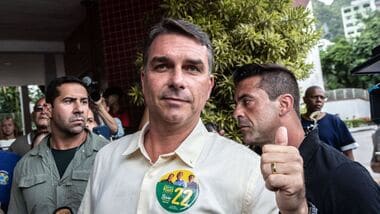
Flávio Bolsonaro is heading to a runoff election in Brazil, buoyed by sweeping gains in Congress. The right-wing senator finished two percentage points ahead of leftist President Luiz Inacio Lula da Silva on Sunday.
Brazil voted in the first round of its presidential elections on 4 October, with incumbent receiving 45% vote against Flávio Bolsonaro’s 47%.
Flávio Bolsonaro inherited his father, the far-right jailed former president Jair Bolsonaro’s surname and powerful poltical base. Bolsonaro senior was sentenced to 27 years for plotting a coup after losing his bid for re-election against his nemesis, Lula da Silva, in 2022.
won the 2018 elections and rejected the 2022 poll results after losing to Lula. Unable to run for office, he chose his eldest son, Flávio, to face off against Lula in the country’s general election this month.
In the first round of the ballot on Sunday, Flávio exceeded expectations, taking 47% of votes compared with Lula’s 45%. Since no candidate won more than half the vote, the election will go to a run-off on October 25, when Lula faces an uphill battle to secure a fourth term and cement his legacy.
Flávio, 45, was little known nationally before his jailed father anointed him as his political heir. But he has struggled to emerge from his father’s shadow, news agency AFP reported.
Flavio’s two-point lead on Sunday came despite a campaign marred by scandal and a corruption investigation. In interviews, he describes himself as a ‘more moderate Bolsonaro,’ but says his father will always be ‘my compass, my point of reference.’
“I know I look like him. But it’s hard to compare Pele’s son to Pele,” he said at a Rio de Janeiro rally, as quoted by news agencies.
While Jair Bolsonaro’s incendiary style is controversial, it fired up the right and helped him go from fringe lawmaker to president in 2018.
Despite his absence under house arrest, Bolsonaro senior’s legacy has loomed large over the campaign. “I would like to have Jair on the ballot. Since Jair isn’t there, I’m going with Flavio,” Marco Antonio da Rosa, a 21-year-old law student at the Rio rally told AFP.
Born in Rio de Janeiro, Flávio Bolsonaro is the eldest of the former president’s four sons, and the one who most closely resembles his father. A law graduate , the Flávio became a state lawmaker in at age 21 and a senator at age 37.
Father to two daughters, he cultivates the image of a devout family man. A key campaign slogan of his is “come with faith.” On the campaign trail, he displayed the relaxed Carioca style and language that the city of Rio is known for.
Flávio often wears jeans and a T-shirt with a targeted slogan: “The Amazon is ours” to emphasize Brazilian sovereignty over the rainforest.
In videos on internet, Flávio does not shy away from tearing up or losing his cool when talking about the plight of his father or what he sees as persecution from the judiciary against his family. In one video showing a busy family morning at home, his dentist wife Fernanda takes credit for him being more mild-mannered than his father, joking: “I re-educated him.”
In September it emerged that Flavio Bolsonaro was under investigation for alleged corruption and money laundering linked to the financing of a biopic, “Dark Horse,” about his father.
The film was bankrolled by banker Daniel Vorcaro, who has been jailed in a multimillion-dollar fraud case.
Flávio Bolsonaro had initially denied any contact with Vorcaro or having flown in his private jet. He was forced to admit both after leaks from the investigation showed them to be true. He also became embroiled in a family feud with his stepmother, the former first lady , who posted an Instagram video saying Flavio Bolsonaro had “disrespected me and mistreated me.”
Michelle Bolsonaro accepted a public apology from Flavio Bolsonaro, but did not appear at any of his rallies.
In an earlier scandal when he was a Rio legislator, Flavio was accused of involvement in a kickback scheme in which he took a portion of his aides’ salaries, but the case was dismissed.
A hardliner on crime, Flávio has praised the controversial security policies of El Salvador’s and called for the building of “many, many prisons” in Brazil.
On social media, he embraces slick ads in which he often appears in a flight suit and aviator glasses piloting a fighter jet on a mission for Brazil. In one, he leans out of the window shooting at drug traffickers on a boat.
“Compared to his father, he is more affable and personable…but that doesn’t mean he isn’t ideologically far-right,” said political analyst Thomas Traumann.
All signs point to a victory for Flávio, reported.
Since Brazil returned to democracy in 1985, no candidate who lost the first round of the election has won the run-off. The other candidates in the race, who received almost 8% of votes, lean towards the right.
In Minas Gerais, Brazil’s most important swing-state and a bellwether for the country, Flávio won by five percentage points. Bolsonaro’s Liberal Party more than doubled its seats in the Senate, to 28 out of 81. It also cemented its position as the biggest party in Brazil’s notoriously fragmented lower house. Almost none of Lula’s allies won new Senate seats or governorships.
Brazilians are tiring of Lula, Economist said in a report. At 81, Lula is serving his third term in office. His Workers’ Party (PT) has been in power for 18 of the past 24 years.
A former trade union leader from Brazil’s poor hinterlands, Lula has failed to connect to younger Brazilians, the report said. The PT remains scarred by two gigantic corruption scandals that erupted during its previous terms. One investigation landed for 1.5 years, though his convictions were overturned in 2021.
Voters in Brazil are also unhappy with the state of the economy. Many voters have not forgiven the PT for a catastrophic recession during the government of Dilma Rousseff, Lula’s handpicked successor, in the early 2010s, the Economist reported.
In Lula’s third term, the government’s spendthrift policies have eroded fiscal credibility. Interest rates have rocketed, raising debt costs for households, businesses and the government. A sense of stagnation prevails despite modest real income gains and record-low unemployment, it said.
“A kilo of meat isn’t worth a day’s work anymore,” Maria Moura, a 22-year-old housewife in Rio de Janeiro told the Economist.
“The bills only rise, and the debts only increase.”
(With inputs from agencies and Economist)