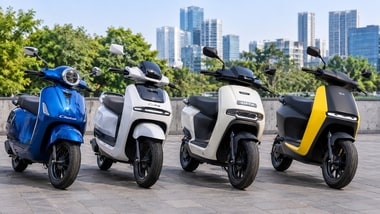
The electric scooter market in India offers buyers several options for daily commuting, with manufacturers competing on battery capacity, riding range, performance and technology. Bajaj Auto’s Chetak electric scooter is among the established options that will compete with others like the TVS iQube, Ather Rizta, and the Ola S1 X.
But which electric scooter offers the best combination of range and everyday features in November 2026? This will vary between models, depending on the manufacturer’s choice of battery type and specification. The updated C Series Chetak has a claimed range of up to 153 km with the IDCs, while other rivals like Ola and TVS boast larger batteries for those seeking longer ranges.
‘s April 2026 product update states that the Chetak C Series comes in various configurations. The C3501 and C3502 offer a 3.5 kWh battery and a claimed range of 153 km. The C3503 offers 151 km, while the C3001 and C2501 deliver 127 km and 113 km, respectively.
This is also the top speed, which has been upgraded to 80 km/h for the C3501 and C3502. The C3501 is equipped with a touchscreen TFT display and a built-in Google Maps navigation system. The C35 and C30 models offer 35 litres of under-seat storage, while the C25 gets 25 litres.
According to TVS Motor, has several battery options for commuters. It comes in a 3.5 kWh model with an IDC range of 145 km and a 4.7 kWh iQube S with an IDC range of 175 km. TVS also offers connected features and storage space, making it a practical alternative to the Chetak.
The Ather Rizta takes a family-oriented approach, with a claimed IDC range of up to 159 km and 34 litres of boot space. It has a Z variant with a touchscreen display and Google Maps navigation. The scooter’s dimensions are crucial to passenger comfort and normal use, according to Ather Energy.
The S1 X series from Ola Electric offers a wider variety of battery options. The 2 kWh, 3 kWh and 4 kWh versions support an IDC range of 108 km, 176 km and 242 km, respectively. This is led by the S1 X+, which has a 320 km range and a 5.2 kWh battery. It has a 4.3-inch colour LCD screen and a claimed maximum speed of 125 kmph.
Charging requirements also matter when choosing an electric scooter. Bajaj says the charging time from 0-80% is 3 hrs for the C3501, and 3 hrs 25 minutes for the C3502 and C3503. The C3001 requires about 2 hours and 55 minutes.
TVS, on the other hand, claims about 3 hours and 45 minutes for charging the iQube 3.5 kWh from 10% to 80%. These figures use different charging intervals and should not be treated as directly comparable.
The can be our top choice for a metal body, recognisable design and convenient storage. The TVS iQube has battery options for longer range, whereas the Ather Rizta is geared towards being family-friendly. The Ola S1 X+ boasts a higher claimed IDC.
However, IDC figures are based on controlled testing. Please note that actual range will vary depending on traffic, speed, passengers, road conditions and weather. Buyers should compare individual variants, check charging facilities and take a test ride before making a decision.