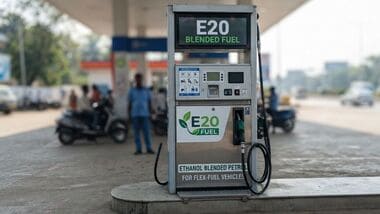
The government has alleged that major oil marketing companies (OMCs) were supplying petrol with ethanol content exceeding the prescribed 20% limit, with laboratory tests recording levels as high as 31.2%. The state government has sought action against the companies and raised concerns over the potential impact on vehicles and consumers.
Addressing a press conference on Friday, Food, Civil Supplies, Consumer Affairs and Legal Metrology Minister Rizwan Arshad said the allegations were based on tests conducted on petrol samples collected from Bengaluru, Kolar, Chikkaballapura, Bengaluru Rural, Ramanagara, Mangaluru and Tumakuru.
According to test results issued by the National Accreditation Board for Testing and Calibration Laboratories-accredited and ISO-certified Shriram Research Institute, Bengaluru, samples from Indian Oil Corporation Limited (IOCL) and Hindustan Petroleum Corporation Limited (HPCL) recorded ethanol content of 31.2% and 30.5%, respectively.
The results also showed ethanol content of 27% in HPCL (MS) petrol, 26.5% in Bharat Petroleum Corporation Limited’s (BPCL) Speed, 26.1% in Nayara, 25.5% in Shell, 24.2% and 22.6% in two BPCL samples, 22.4% in another HPCL sample and 20.8% in another IOCL sample.
Among the remaining samples in the Motor Spirit (MS) category, ethanol content was recorded at 20.6% in Nayara petrol, 19.9% in a BPCL sample, 19.2% in a Mangalore Refinery and Petrochemicals Limited (MRPL) sample and 13.5% in a Shell sample.
Arshad said samples collected from major fuel companies had revealed ethanol content exceeding 20%, with IOCL and HPCL recording the highest levels of 31.2% and 30.5%, respectively.
“The oil companies are blending above 20%. The problem is, E20 compliant vehicles are being manufactured in the country from 2023 onwards. Out of the total vehicles, hardly a few percentage of vehicles have E20 compliance,” Arshad said.
According to him, ethanol blending beyond E20 could also create problems for vehicles designed to run on E20-compliant fuel.
“99 per cent of vehicles cannot handle any fuel beyond E20,” the minister said, referring to the ethanol blending.
Arshad said prominent automobile manufacturers had initially stated that their vehicles were not compatible with 20% ethanol blending.
“But after (Central) government intervention, what transpired, we don’t know. Whether it was an explanation or anything else. All these companies kept quiet on that,” he claimed.
The minister also raised concerns over whether vehicle warranties covered damage caused by E20 fuel.
A press release issued by him alleged that petrol samples were initially submitted to the in-house laboratories of IOCL and BPCL, but their test reports did not disclose the ethanol content, despite it being one of the prescribed testing parameters.
“This omission raises serious questions about the transparency of the oil marketing companies and what they seek to conceal from consumers,” the release said.
The Karnataka government said consumers were bearing a financial burden due to alleged over-blending, citing reduced mileage and possible damage to vehicle components, including filters, fuel pumps, injectors, hoses and seals.
It claimed that 99% of India’s 35 crore vehicles were not designed to run on ethanol blends exceeding E20. It further said that even vehicles sold after April 2023 were certified only for blends containing up to 20% ethanol.
The state government also questioned the readiness of fuel dispensing infrastructure, stating that most dispensing units currently in use at petrol pumps were designed to handle blends containing only up to 15% ethanol.
Karnataka seeks compensation, mandatory fuel blend disclosure
The state government has sought action against OMCs found supplying petrol containing more than 20% ethanol. Its demands also include compensation for consumers whose vehicles have suffered damage, mandatory nationwide display of ethanol blend percentages at fuel stations and the availability of different fuel blends to give consumers a choice.
It has also demanded the establishment of an E20 spoilage fund to compensate affected consumers through a time-bound claims process. Vehicle damage would be certified by authorised service centres under the proposed mechanism.
“The Government of India must publicly clarify the actual ethanol blend being supplied to consumers,” the release said.
Arshad said the Union Ministers of Road Transport and Highways and Petroleum and Natural Gas owed an explanation to every Indian, as evidence of alleged over-blending had now been placed on record.
He also questioned the consumer benefits of the Centre’s ethanol-blending policy, saying the government’s argument that blending helped save foreign exchange had not translated into any tangible benefit for consumers.
The minister demanded that every petrol pump across the country be required to display the ethanol blend percentage, allowing consumers to make an informed choice among available fuel blends.
Karnataka invokes fuel supply regulations to act against malpractices
The release said the Karnataka government had empowered officials under the Motor Spirit and High Speed Diesel (Regulation of Supply and Distribution and Prevention of Malpractices) Order, 2005, to take action against malpractices in fuel supply and distribution.
It said the powers had been conferred on designated officials through a notification dated April 15, 2009. The government said it would ensure “an accurate measure and a quality guarantee for every litre its people pay for” under Mission Nikhara, launched by Arshad.
The state government said it would continue conducting tests across Karnataka and make its findings public.
There was no immediate response from the oil marketing companies to the allegations.
(PTI Inputs included)