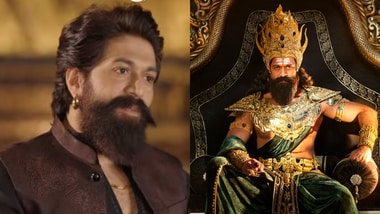
Actor Yash’s role in goes beyond playing Ravana. The Kannada star is also a co-producer on the two-part epic, and his involvement has brought a different business arrangement to the project. Instead of taking a conventional acting fee upfront, Yash has chosen to be involved as a producer, with his earnings linked to the film’s performance.
The arrangement means the makers do not have to account for a large fixed acting fee for one of the film’s leading stars. In return, Yash has a stake in the project and stands to benefit if it performs well commercially. It also means he shares the risk if the film does not meet expectations.
Yash’s production company, Monster Mind Creations, joined hands with Namit Malhotra’s Prime Focus Studios to produce the film. The partnership was announced in April 2024. Yash is therefore involved in the project both as an actor and as a producer.
The actor has also spoken about his approach to film remuneration. In an interview with , he said he does not ask for his fee upfront and prefers to work in partnership with producers. He explained his approach as, “We earn money together and lose money together.”
Prominent Indian film trade analyst Komal Nahta said the arrangement is not unusual among leading actors, although some choose a combination of and remuneration.
“A lot of actors do what Yash has done, but sometimes it’s part profit and part remuneration. Yash, if he has chosen to only take profits, it’s a good thing. Yes, that much cost or burden on the film is reduced. So plus I think he must be very sure about the project. Ramayana itself is such a wonderful subject to make, and he must have seen ‘s vision when he went to sign him, as well as the film’s lavish scale. So I think he must have actually turned producer or joined him as a producer because of Namit Malhotra’s excitement about the project and his commitment to it. And then he must have decided that, ‘Yes, I’ll not take any remuneration. You give me a larger share in profit.’ I think it works well for both of them, a win-win situation for both of them, unless, of course, the film would have failed. But the chances of the film failing were very, very remote.”
Film trade analyst Ramesh Bala also sees the move as a business decision that connects Yash’s earnings to the film’s performance.
He said, “Yash choosing equity over a conventional acting fee for Ramayana is a smart business move. Instead of taking a huge upfront remuneration, he is investing in the film’s long-term potential. This significantly reduces the immediate financial burden on the producers while giving Yash a share in the film’s commercial success.
“With a project of this scale and global ambition, the upside could be far greater than a fixed salary. Of course, he is also sharing the financial risk. This is a model where the star becomes a stakeholder rather than just an actor, and it could encourage more leading stars to explore similar arrangements for big-budget films,” added Bala.
Akshay Rathi, director of Ashirwad Theatres Pvt Ltd and a leading film exhibitor, said this approach could become more common among A-list actors. He pointed to the value of owning a part of a film beyond its theatrical run and said, “I think it’s actually something that I expect most A-list stars to do because, you know, there’s no greater testimony to showing the confidence that you have in your work and your own abilities than backing yourself. And here, I truly think, you know, Yash and various other stars are doing that. Mr has been doing it for a while. Mr Akshay Kumar does it in a lot of films. Mr Ajay Devgn does it in a lot of films by bringing in IP. They’re not just ensuring that the payoff is really linked to their abilities and their success with the film, but they also own a part of the film, whose intellectual property rights going forward can be a wealth creator for them.
“So I really think there’s a lot of wisdom in it, there’s a lot of bravery in it. And I really think that for literally every A-lister, this is the way forward, which will benefit them and their films. It will allow their films the budgets and, you know, the disposable cash flows to mount the films on a bigger scale. And it will, you know, give the films a better chance to succeed because more money can then be put into making the film rather than the remuneration of the stars. This has been the case for a while with a lot of stars, and I really hope all A-listers follow this and show their belief in themselves more than anything else,” he said.
The scale of Ramayana makes the arrangement particularly significant. Yash has confirmed that the reported ₹4,000 crore budget covers both parts of the film, along with post-production and promotional expenses. The project is directed by Nitesh Tiwari and features Ranbir Kapoor as Lord Rama, Sai Pallavi as Sita and Yash as Ravana. However, given the pace of the film, it can be assumed that the film might have more than two parts.
For Yash, the decision places him on both sides of the project. He is not only part of the cast but also has a business interest in how the film performs. While a fixed acting fee would offer a defined payment, a producer’s stake could bring greater returns if the film succeeds. The other side of that decision is the risk of sharing any losses.