



India’s truck and tractor markets have grown by nearly a fifth in the first half of FY27, signalling strength across freight and farm-linked demand. But September has revealed a widening split in momentum.
Commercial vehicle registrations accelerated 37.62 per cent y-o-y and 14.09 per cent from August, led by a 46.22 per cent surge in heavy trucks, while tractors fell 12.58 per cent sequentially despite remaining above last year. Electrification is also beginning to make inroads into commercial transport, with EVs accounting for 4.04 per cent of September CV registrations, nearly double their 2.16 per cent share a year earlier.
CV registrations rose 21.48 per cent during April-September to 5,85,217 units from 4,81,723 a year earlier, while tractors increased 19.81 per cent to 5,56,862 from 4,64,778, according to Federation of Automobile Dealers Associations (FADA) data. The two categories, therefore, entered September with remarkably similar first-half growth rates before moving in sharply different directions at the half-year close.
“Commercial vehicles maintained robust momentum,” said FADA President Sai Giridhar, attributing the strength to replacement demand, infrastructure and mining activity, and bulk fleet purchases for steel and cement movement, alongside higher rural incomes and purchases ahead of expected price increases.
The acceleration was strongest among heavy CVs. HCV registrations surged 46.22 per cent y-o-y and 21.28 per cent from August to 32,310 units in September. Light CVs rose 34.13 per cent y-o-y and 11.48 per cent sequentially, while medium CVs increased 33.96 per cent and 8.61 per cent, respectively.
The truck recovery is also beginning to acquire an electric dimension. EVs accounted for 4.04 per cent of CV registrations in September, up from 2.16 per cent a year earlier. Based on overall CV volumes, that translates into roughly 4,200 electric commercial vehicles against about 1,600 a year earlier, albeit from a small base.
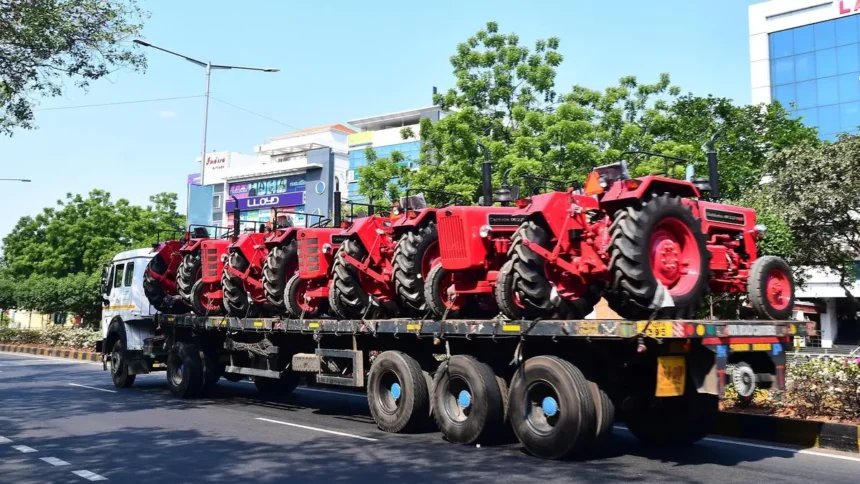
Tractors moved differently. September registrations remained 13.75 per cent higher y-o-y at 76,906 units but fell 12.58 per cent from August, contrasting with their 19.81 per cent growth through H1.
Giridhar attributed the sequential decline to “patchy monsoon conditions and the later festive calendar,” even as tractor demand remained positive y-o-y.
The September split leaves two economically sensitive categories entering H2 differently: trucks carried their strong H1 performance into the month and accelerated, led by HCVs, while tractors retained y-o-y growth but lost sequential momentum.
Published on October 6, 2026