



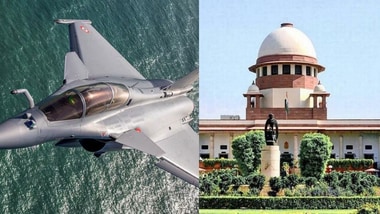
The has directed the Centre to re-induct former Short Service Commission (SSC) officer Priyanka Saxena into the Indian Air Force, observing that existing rehabilitation policies for war widows do not cover women in her situation, news agency ANI reported.
A bench comprising and Justices Joymalya Bagchi and V Mohana said Saxena’s case was unusual because she had previously served in the IAF and later became the widow of an Air Force officer who died in a fighter aircraft crash.
The court said her earlier military service should be taken into account and that she should not be required to undergo the complete pre-commission training prescribed for war widows being inducted solely on the basis of their academic qualifications.
“This is a case of the appellant becoming eligible on both counts; her being an ex-Air Force officer, and she being a war widow of an Air Force officer,” the bench was quoted as saying by ANI.
Priyanka Saxena joined the Indian Air Force at the Air Force Academy in Hyderabad in January 2002 and received her commission on 20 December 2003. She was posted to 41 Wing in Jaisalmer and later married Wing Commander Harshit Sinha on 13 November 2006, according to a report by Deccan Herald.
Saxena continued serving in the IAF after her marriage and received a Commendation from the Air Officer Commanding-in-Chief, Western Air Command.
She became a mother in May 2012 when her first daughter was born. Citing family responsibilities and the need to support her husband, who was a fighter pilot, she chose not to seek an extension or permanent commission after completing her initial SSC tenure.
Her second daughter was born in June 2016.
On 24 December 2021, Sinha, who was then the Flight Commander of 51 Squadron “Sword Arms” in Srinagar, died in a MiG-21 Bison crash near Jaisalmer airfield.
Following her husband’s death, Saxena sought reinstatement in the IAF, pointing to her previous decade of service. The Centre rejected her request in April 2022.
She then moved the Armed Forces Tribunal in New Delhi, seeking changes to existing policies so that women officers who had previously served in the armed forces and subsequently became widows of defence personnel could also be considered for re-induction.
The tribunal observed that officers who had completed 10 or 14 years of service represented a trained pool of personnel who could continue contributing to the armed forces. It also said their re-induction could help in the rehabilitation of “Veer Naris”.
The Centre argued that a separate policy was unnecessary and maintained that Saxena was already beyond the maximum age of 35 prescribed under a November 2017 policy letter. The tribunal dismissed her plea in July 2024.
Before the Supreme Court, the Centre said Saxena had voluntarily left the Air Force after completing her SSC tenure and therefore could not seek reinstatement by relying on the principles laid down in the Babita Puniya judgment.
The government also argued that the age relaxation available to widows was limited to eligibility for pre-commission training and did not apply to Saxena’s case.
The Supreme Court, however, found that her circumstances were not addressed by the existing rehabilitation framework.
The bench held that Saxena’s previous service as an SSC officer was relevant while considering her case for re-induction. It noted that age relaxation had been made available in other contexts to SSC officers seeking entry into civil services.
“The appellant’s case is one of a widow of a fighter pilot who was serving in the Indian Air Force and who lost his life in an aircraft crash. The appellant is a war widow having two school-going minor daughters, and her case deserves to be considered sympathetically,” the court observed.
The Supreme Court invoked its powers under Article 142 of the Constitution to provide relief in Saxena’s case. However, it specifically directed that the order be treated as a one-off arrangement and not as a precedent for other cases.
Under the Supreme Court’s directions, Saxena will undergo a one-year refresher training course from the next applicable batch and will have to meet the prescribed medical requirements.
She will be re-inducted as a Squadron Leader in the eleventh year of service, with her earlier service included in the calculation. She will continue as a Short Service Commissioned officer and receive a four-year extension in accordance with the applicable policy.
Her inter-se seniority will be determined alongside her current peer group. Any future consideration for permanent commission or promotion will also be governed by the policies applicable to that group.
The Supreme Court set aside the Armed Forces Tribunal’s orders while reiterating that its decision was based on the specific circumstances of Saxena’s case and should not be treated as a precedent.
(With inputs from news agency ANI)