



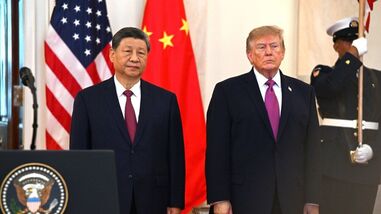
The latest US-China understanding may have been driven by tariffs, but an emerging area of cooperation between the world’s two biggest economies is artificial intelligence (AI).
China said on Saturday that Beijing and Washington had agreed to launch a dialogue on AI risks and benefits, with the next round of discussions scheduled for November. The two sides will also establish a communication channel for AI-related incidents, according to China’s Foreign Ministry.
The move came under an eight-point consensus reached during Chinese President Xi Jinping’s three-day visit to Washington, which ended on Friday. The summit also produced an agreement on a $30 billion reciprocal tariff-reduction arrangement, a trade council and an extension of outcomes from earlier talks in Kuala Lumpur.
The proposed communication channel could provide the US and China with a direct mechanism for communication if major AI-related incidents arise.
China also drew attention to Washington’s use of the term “super intelligence” instead of “artificial intelligence”.
“Like almost everyone else, (Xi) seemed to like calling the poorly and inaccurately named Artificial Intelligence to a far more accurate and important name, SUPER INTELLIGENCE,” Trump wrote on his social media platform after talks with Xi.
China has not explicitly confirmed or denied Trump’s characterisation of the discussion.
Beijing’s foreign ministry said on Saturday it “attaches importance” to Trump’s adoption of the term.
“Regarding the artificial intelligence phrasing question, the Chinese side attaches importance to the US side’s position and respects the US side’s wording,” the ministry said in a statement.
“Artificial intelligence technologies are continuously developing, all parties can strengthen exchanges, discuss in-depth and seek consensus in light of the latest situation,” said the statement from an unidentified ministry spokesperson said.
The AI understanding was part of a broader attempt to stabilise US-China relations. The two countries had earlier agreed to extend their trade truce by two months beyond its November 10 expiry, providing more time to negotiate a potentially broader trade agreement, US Treasury Secretary Scott Bessent said.
The three-day summit between Xi and President Donald Trump, which ended on Friday, showcased personal diplomacy rather than big public breakthroughs.
“This historic visit enriched the constructive and stable China-US relationship, upheld the overall stability of bilateral ties, opened a new chapter in China-US relations, and will have a far-reaching impact on world peace and development,” Chinese Foreign Minister Wang Yi said in a statement.
Xi has since landed in Beijing, Chinese state news agency Xinhua reported on Saturday.
The two sides also agreed to support each other in hosting the Asia-Pacific Economic Cooperation leaders’ meeting and the Group of 20 summit, with both leaders planning to attend the gatherings hosted by the other