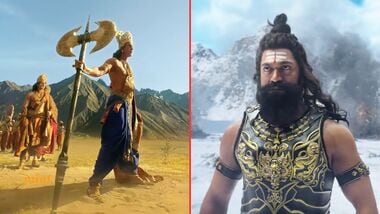
Nitesh Tiwari’s much-anticipated adaptation of the has received encouraging early reviews, with international film critic Peter Bradshaw of describing the three-hour blockbuster as “highly enjoyable”.
In his review, Bradshaw called the film a “thoroughly engaging, rousing and spectacular Indian epic melodrama”, praising its enormous scale and storytelling. He also drew comparisons with Peter Jackson’s Lord of the Rings and Disney’s The Lion King, noting the film’s expansive visual canvas and elaborate landscapes.
Avi Offer of NYC Movie Guru called the movie ‘a visually dazzling action adventure with great set and costume design.
Early reactions on X (formerly Twitter) have also been largely positive, with viewers praising the performances, visual effects, action sequences and music.
A user reviewing the film on X described it as “A grand cinematic experience with beautiful visuals, powerful performances and an emotional story.” The user also praised its background music and action sequences, while noting that the pacing felt slow in some portions.
Another X user, itscinema, called the film an “EPIC ALL TIME BLOCKBUSTER”, praising Ranbir Kapoor’s portrayal of Lord Rama and Yash’s performance as Ravana.
Dhruwal Patel also praised director Nitesh Tiwari’s treatment of the epic, writing that the filmmaker had approached the story with reverence. Patel described Kapoor’s Rama as “calm, graceful and deeply moving”, while praising Yash’s portrayal of Ravana for its “power and menace”. He also appreciated Sai Pallavi’s performance as Sita and Ravi Dubey’s portrayal of Lakshman.
Film critic Aavishkar, meanwhile, described Ramayana: Part One as “Not Just the Finest Cinematic Adaptation of the Epic, But an Extraordinary Experience!”
Starring as Lord Rama, as Sita and Yash as Ravana, Ramayana is scheduled to release in theatres across India on Thursday.
Directed by Nitesh Tiwari, the film is a two-part cinematic adaptation of one of India’s most revered epics. It is produced by Namit Malhotra’s Prime Focus Studios in collaboration with DNEG and Yash’s Monster Mind.
Oscar-winning composers Hans Zimmer and A R Rahman have collaborated on the film’s score, while Terry Notary and Guy Norris are part of its action team.
The first instalment will release in Hindi, Tamil, Telugu, Kannada and Malayalam across multiple formats, including IMAX. The second part is scheduled for release in 2028.
The film’s scale, star cast and cultural significance have led to substantial box-office expectations. Trade estimates suggest that Ramayana could collect ₹75-100 crore on its opening day across languages, while its lifetime collections have been projected at ₹1,000 crore to ₹3,000 crore, depending on audience response.
Film exhibitor Vishek Chauhan told PTI that the film would be difficult to assess using conventional review standards, as a significant section of its audience would approach it through faith and devotion.
“You cannot call “Ramayana” a classic film like ‘Dhurandhar’, ‘Border’ or ‘Baahubali’, this is a different genre of filmmaking. This is about religion, it is faith-based cinema,” he said.
Veteran distributor and exhibitor Raj Bansal also believes the film could surpass the box-office collections of the Dhurandhar franchise, which reportedly stand at over ₹3,000 crore.
Akshaye Rathi said the film’s storytelling, technical execution and scale could help it establish new box-office benchmarks.
Sameer Munshi, chief operating officer of Miraj Entertainment Ltd, expects the film to open at ₹75-80 crore net or ₹100 crore gross across languages in India.
Ashish Misra, head of commercialisation at Cinépolis India, said the chain had sold more than one lakh tickets and planned over 1,600 shows on opening day.
However, trade expert Ramesh Bala cautioned that the film faces competition from regional releases, including Suriya’s Scene and Nayanthara’s Mookuthi Amman 2. He estimated Ramayana’s South Indian collections at ₹30-40 crore and said its performance would depend heavily on word of mouth.
With its Diwali-period release, extensive theatrical distribution and early international praise, Ramayana now faces the crucial test of translating anticipation into audience turnout.