



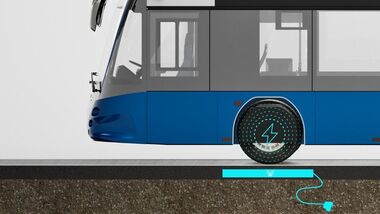
Imagine an electric bus pulling into a regular bus stop and charging its battery without plugging into a cable. That is the idea behind a new charging system being developed by Swiss startup Winduction, an ETH Zurich spin-off.
The company has developed an electric bus prototype that can draw power through specially designed tyres when it stops over a charging plate embedded in the road.
The technology is aimed at reducing the need for large battery packs and allowing electric buses to recharge during their normal routes.
The system uses wireless power transfer.
A charging plate installed in the road is connected to the electricity grid. When the bus stops above the plate, coils inside the plate generate a magnetic field.
Winduction has placed another set of receiving coils inside a specially designed bus tyre. These coils capture the energy from the magnetic field and transfer it to the bus’s battery.
“The only thing that always has contact with the ground on any vehicle is the wheel,” digital media publisher Interesting Engineering quoted Sylvan Fricker, an ETH Zurich alumnus responsible for the technology at Winduction, as saying.
Conventional wireless EV charging systems generally have one coil in the ground and another underneath the vehicle.
The distance between the two coils can be relatively large and varies depending on the vehicle’s design. A greater transmission distance can affect charging efficiency.
Winduction’s approach brings the receiving coil much closer to the road by putting it inside the wheel.
“We minimize the large transmission distance between the road and the chassis by integrating coils into the wheel,” Fricker said, according to Interesting Engineering.
The company says its system has achieved more than 90% road-to-vehicle energy transfer efficiency, meaning less than 10% of the energy is lost during the transfer.
Putting electrical components inside a rotating tyre requires a different design from conventional tyres.
Winduction is working with partners to develop a completely new steel-free tyre for the system.
“To ensure our system works, we are collaborating with partners to develop a completely new, steel-free tire,” CEO Laurin Schwitter said, according to the digital media publisher.
The tyres are expected to cost more individually than conventional ones. However, Winduction believes the additional cost could be relatively small compared with the overall cost of buying and operating an electric bus.
The technology is still at the prototype and testing stage.
Winduction is building testing infrastructure in Winterthur, Switzerland, and plans to conduct its first passenger-carrying pilot in 2028.