


Late May in New Delhi, a 20th floor room at hotel Le Méridien was thick with polite scepticism.
A few journalists gathered to hear how . planned to claw its way back in India. The stakes couldn’t have been higher: the parent automaker was reeling from its first-ever global loss, bruised by billions in write-offs. Across the table, the management team of Honda Cars India Ltd rolled out a familiar —a decade-spanning playbook featuring 10 new models in four years, a captive finance division to grease consumer loans, and an expanded lineup of hybrids and (EVs).
It sounded ambitious. But when asked to put a number on this grand comeback—to name the actual sales target for the next four years—the curtain suddenly dropped.
“At this moment, we cannot tell so much in detail figures,” replied Takashi Nakajima, the chief executive of Honda Cars India.
The silence that followed spoke volumes. To industry observers, Honda wasn’t just being discreet; it was playing a weak hand. In a competitive Indian market dominated by aggressive local titans and surging international rivals, Honda’s arsenal looked sparse. Baffled competitors and analysts settled in to wait for the delayed offensive.
Then came the plot twist.
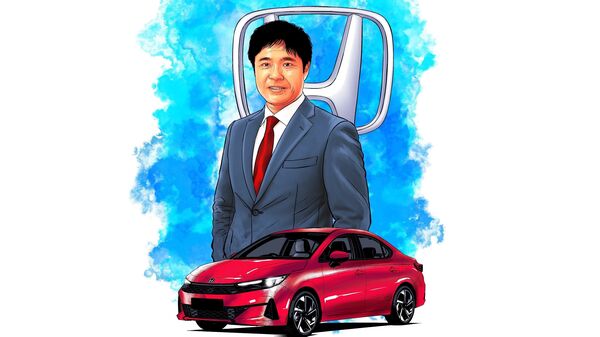
Just two months after laying out the strategy, Honda announced a sudden executive reshuffle. Nakajima, who had only taken the helm in April 2025, was out. Replacing him this October is Toshiyuki Yanagisawa. He would be the fourth chief executive of Honda Cars India in the last eight years.
By abruptly tearing up its decades-old policy of rotating Indian leadership every three years, Honda signalled urgency. Yanagisawa now inherits a brand at a high-stakes crossroads—handed the keys mid-turn, charged with turning a modest May announcement into a full-scale market resurrection.
To understand Honda’s current predicament in India, you have to look at a brutal set of numbers: in FY20, the Japanese automaker moved 116,264 vehicles, claiming a 4.19% slice of the country’s passenger vehicle market, the world’s third largest.
Six years later, as a post-tax-cut buying boom lifted the rest of the industry by 13%, Honda’s sales nearly halved to just 60,826 units when compared to FY20. Its market share collapsed to a razor-thin 1.29%.
The Japanese carmaker is 9th in the pecking order by market share, a list led by (39.7% share in FY26), (13.4%) and (13%), according to data from the Federation of Automobile Dealers Association.
It is the classic story of a brand caught sleeping through seismic market shifts.
Honda’s journey in India started with flair. Arriving in 1995 among the golden wave of post-liberalization foreign automakers—alongside Ford, Hyundai, and General Motors—Honda quickly became an aspirational status symbol. For over a decade, its name was synonymous with sturdy engineering, propelled by the success of sedans like City and Amaze.
Then came two massive, industry-defining pivots. Honda missed both.
The first arrived in the late 2000s when India fell in love with diesel. Petrol-loyal Honda hesitated. By the time Honda finally brought its first diesel engine to the market in 2013, the gold rush was already waning as fuel prices normalized. In a twist of fate, Toshiyuki Yanagisawa—the man now taking the helm to fix the company—was posted in India between 2009 and 2013, watching firsthand as the market drifted away.
The second shift was even more decisive: the sports utility vehicle (SUV) revolution. Between 2012 and 2015, game-changers like the Renault Duster, Ford EcoSport, and Hyundai Creta rewrote the Indian car playbook. Buyers deserted sedans and hatchbacks in droves, preferring more muscular vehicles.
Honda tried to react, but its responses lacked muscle. It introduced the BR-V, a seven-seater. But it failed to take down the dominant Creta. It also brought in the WR-V, a jacked-up hatchback derived from the Jazz platform. It couldn’t match Maruti’s Brezza.
By missing those market transitions, a brand that once defined premium motoring found itself watching from the sidelines, struggling to catch up.
Between 2019 and 2023, Honda a series of cars across its portfolio—the BR-V, WR-V, Jazz, Brio, Civic, and Accord among others. By the end of 2023, it was left with only three car models in India—Amaze, Elevate and City.
So, what explains Yanagisawa’s sudden appointment?
Inside Honda, the message from Tokyo was clear: grand strategies mean nothing without execution. Alongside the US and Japan, the parent company has identified India as one of three key global markets for future growth. But to achieve that growth, it had to buckle up.
A senior executive aware of the internal discussions revealed that the leadership swap is a direct response to this high-stakes mandate. “He (Yanagisawa) has been a part of making the India strategy so the change has been made for better execution,” the senior executive, who did not want to be identified, said.
Yanagisawa has been heading the ‘India strategic development office’ since 2024.
The ambitious roadmap, aiming for more than 10 launches by 2030, intends to push the brand into entirely new segments while expanding across hybrids and battery EVs.
Kunal Behl, vice president of marketing and sales at Honda Cars India, told Mint that the company’s aspiration was “clearly to grow significantly” from its current baseline.
“With the product roadmap we have put in place, we expect both our volumes and our presence in the Indian market to expand substantially over the coming years,” he said in an e-mail response. “As our portfolio expands, market share will follow.”
By cutting short the usual corporate handover, Tokyo is placing a direct bet on the man who was part of the blueprints. As Behl put it: “As we now move from strategy into a critical execution phase, this transition brings continuity and a strong focus on delivering our growth plans for India.”
Executing that playbook, however, is a monumental task.
For industry veterans watching from the sidelines, Honda’s fundamental hurdle isn’t a lack of ambition—it’s whether its cars can actually connect with the Indian driver. Elevate, for instance, was developed in Thailand before being introduced in India. In May, Honda said it plans to introduce a premium SUV, ZR-V, which will only be imported from Japan. Carmakers like and , in contrast, relied on cars designed for the Indian customer—Kylaq and Duster.
“Honda’s challenge in India has rarely been intent—it’s traction. Part of the answer lies in getting the fundamentals right, starting with the vehicle’s dimensions,” noted Gaurav Vangaal, associate director at auto analytics firm Mobility Global.
Indian buyers increasingly crave muscular road presence, favouring wide, commanding silhouettes that command the tarmac. Honda, Vangaal argued, must hit this head-on to win back the street.
Tokyo’s C-suite finally seems to get it. In May, Honda’s global CEO Toshihiro Mibe conceded that localized engineering is non-negotiable, promising: “In 2028, Honda will begin introducing strategic models tailored to the Indian market in two vehicle categories: vehicles under 4 metres in length and the mid-size category.”
Yet, in a haunting replay of its late arrivals to the diesel and SUV gold rushes, analysts fear Honda might be arriving fashionably late to its own party. Mid-size and sub-4-metre compact SUVs already eat up more than three-fourths of India’s SUV market.
“Waiting until 2028 for the first India-made model (specifically catering to India) means giving away valuable ground in the most dynamic part of the market. By then, the leading players will have moved through another cycle of launches and refreshes,” Vangaal warned.
Vinay Piparsania, founder at Millenstrat Advisory and Research and a former Ford India executive, echoed the sense of ticking clock anxiety. “Two more years is a long runway in a market where Maruti, Hyundai and Tata are entrenching further by the month in exactly the sub-4-metre SUV segment Honda is targeting. In today’s market, speed to market is as important as the product itself,” Piparsania noted.
Ultimately, playing safe won’t cut it anymore. As one senior executive with decades of experience at foreign carmakers put it: “The question they will have to answer is, what is their audacious bet which can get them some market visibility?”
Yet, even as the clock ticks, Honda is refusing to trade its legendary engineering standards for a quick fix.
Kunal Behl insists that while product development is moving at breakneck speed, quality remains unshakeable. “At the same time, we want to ensure that every product is right for India and delivers the quality, safety and value expected from Honda,” the executive said.
To fight its way back, Honda is planning a multi-front assault. Rather than relying solely on SUVs, it is doubling down on its traditional fortress—the sedan—using fresh facelifts alongside next-gen hybrid and battery-electric powertrains to reignite buyer interest.
It is a high-stakes play, but one backed by formidable legacy assets. “We have a strong brand and in the segments where we are present, our products have built a strong positioning and continue to be well accepted by customers. We also have a strong and trusted dealer network across the country, which has been an important strength for the Honda brand,” Behl noted.
Having missed two massive market shifts in the past, Honda is determined not to sleep on the next big wave: millions of ambitious Indians looking to trade up from two wheels to four.
“One unique strength we have in India is our large base of customers. They are already part of the Honda family through our two-wheelers. As their aspirations and mobility needs evolve, we see a significant opportunity to bring many of them into the four-wheeler family,” Behl said.
In fact, the carmaker could look to borrow from the playbook of its sister two-wheeler company, Honda Motorcycle and Scooter India Pvt. Ltd, which is India’s second largest two-wheeler player behind . Honda’s two wheeler sales have grown from 4.7 million to 5.3 million between FY20 and FY26.
So, what could be the secret weapon for this cross-segment migration? Honda Finance, which will be in operation by the end of this fiscal year. By leveraging artificial intelligence and other digital platforms to streamline loans and map buyer behaviour, the brand’s captive finance arm could be the catalyst that finally turns two-wheel loyalists into Honda drivers—giving the Japanese titan the local footing it has sought for decades.