


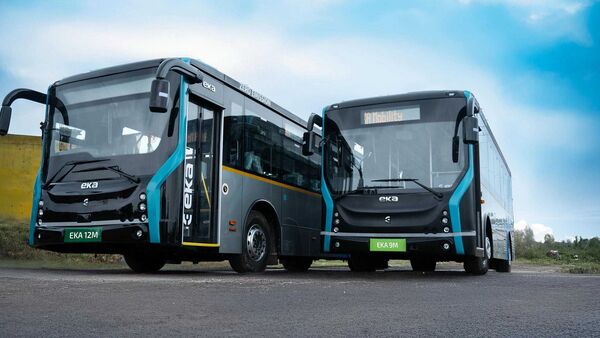
NEW DELHI: Eka Mobility, a new-age electric bus maker, has secured over ₹1,400 crore in debt this year, marking its biggest funding drive as it sets out to deliver on two major government orders it won against established rivals and expands its market presence.
Eka was awarded a ₹1,306 crore lending facility by a consortium of banks in February and it issued ₹100 crore worth of debentures to ICICI Prudential Corporate Credit Opportunities Fund AIF last month, with its board approving raising another ₹400 crore through debentures, according to company filings reviewed by Mint.
The borrowings follow a $57 million ( ₹500 crore) funding round in October last year led by the National Investment and Infrastructure Fund, an alternative asset manager anchored by the Indian government.
Since December 2025, Eka has won contracts for 3,485 buses in a 10,900-bus tender and secured orders for 3,981 buses in subsequent tenders for 6,230 buses floated by the Centre’s Convergence Energy Services Ltd, outbidding established companies Tata Motors and Ashok Leyland.
The raising of structured debt marks a shift among companies such as Eka, which have so far relied on equity funding, according to experts.
Koushik Bhattacharyya, managing director and head of industrials investment banking at Avendus Capital, said electric bus companies are attracting different types of investors, depending on their business models.
“E-mobility as a service (eMaaS) platforms are attracting infrastructure funds and structured-finance investors versus OEMs getting interest from pure equity capital providers – both sponsors and strategics,” Bhattacharyya said. “PMI and Greencell, which are a mix of eMaaS and OEM, are good examples of the former, with capital increasingly structured around contracted cash flows and target IRRs, while companies like Eka, which are pure OEMs, have been funded predominantly through equity.”
Eka tied up with eMaaS providers, which act as fleet operators, to participate in e-bus tenders floated by the government. While OEMs manufacture and sell buses, fleet operators procure and run them on contracts with state agencies for more than a decade, being paid on a per-km basis.
Bhattacharyya said the government order wins have had a different impact on funding for the two business models.
“Government order wins are consequently a much bigger catalyst for the eMaaS financing model than for the OEM model,” he said.
Founded in 2019, Pune-based Eka Mobility is a subsidiary of automotive seating and interiors maker Pinnacle Industries. The company entered the electric bus market in 2022 and has tied up with Japan’s Mitsui and the VDL Groep of the Netherlands for strategic investment and technology collaboration. The company, led by founder and chairman Sudhir Mehta, reported an annual manufacturing capacity of 6,000 electric buses.
The funding push comes as India’s electric bus market gathers pace. Mint reported on 5 October that electric bus sales rose 55% year-on-year to 3,723 units in April-September, the highest for the first half of any fiscal year, according to government data.
With the e-bus sector gathering pace, the funding momentum has risen for other new-age companies. In March, US private equity firm KKR said it plans to invest up to $310 million in PMI Electro and its electric bus platform Allfleet India, acquiring a minority stake in the manufacturer and a majority stake in Allfleet.
Electric buses accounted for 8.55% of total bus sales in H1, up from 5.47% a year earlier, even as overall bus sales fell 0.4% to 43,561 units. Government tenders have been the key driver, with schemes such as PM E-Drive and PM E-Bus Sewa supporting the shift from diesel to electric buses in public transport.