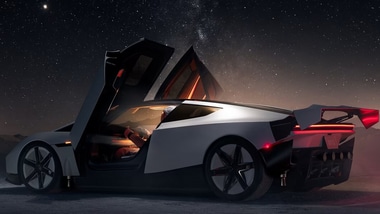
Tesla has unveiled its redesigned second-generation Roadster electric sports car with SpaceX-inspired thrusters at a livestreamed event in Texas on Thursday, October 15, 2026.
The presentation was led by CEO Elon Musk, who showed the two-seater EV performing dramatic aerial manoeuvres with the help of compressed-air thrusters, and it will soon enter production in 2028 following many years of delays.
The new Roadster is meant to be Tesla’s high-performance offering and features tech similar to SpaceX. Musk has said that the vehicle can go from 0 to 60 mph (0-97 kmph) in less than 1 second and exceed 230 mph (370 kmph). However, Tesla has not announced the final pricing, and the legality of its airborne features on public roads remains unclear.
will offer the new Roadster in three configurations: Performance, Thrust and Rocket. The Performance variant is said to be road-ready, while the Thrust version sports rear-mounted cold-gas thrusters. It’s a one-seater with a full flight system and is available only by invitation.
Tesla’s site says the reservation deposit for the Performance is $50,000, while the deposit for the Thrust is $250,000. The company has not announced the final prices of the variants. All three are said to have a range of 300 miles (about 483 km) and a maximum speed of over 230 mph.
The car is equipped with 10 thrusters powered by 600 litres of compressed air to lift and rotate it in the air, Tesla engineering vice president Lars Moravy said at the event. also announced on X that the vehicle features carbon-fibre over-wrapped compressed-air pressure vessels.
The second-generation Roadster was first revealed in November 2017, with deliveries expected in 2020. Several delays followed due to the company’s focus on other vehicles and manufacturing issues. Musk also discussed adding rocket thrusters to the car in 2018.
Earlier, had announced a $200,000 base price for the Roadster. The company hasn’t announced any specific delivery date or final price for the new model yet, but it has set its 2028 production target.
The launch is part of Tesla’s growing emphasis on autonomous driving, artificial intelligence and robotics, as well as its electric vehicle operations. The company has now launched the Cybercab robotaxi and continues developing the Optimus humanoid robot.
Morningstar analyst Seth Goldstein called the Roadster a “halo car”, a way for Tesla to demonstrate its engineering and design prowess. However, Reuters reported that Goldstein said he expects annual sales of around 2,000 units, a small fraction of Tesla’s total vehicle output.
The Roadster’s long development period and out-of-the-box thruster design have raised questions regarding production viability, road safety and the feasibility of the show-stopper features, despite its technological goals.