



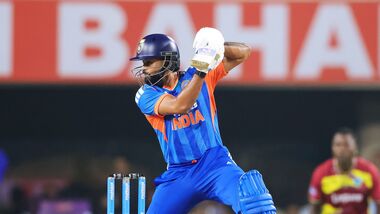
Shreyas Iyer’s appointment as India’s T20I captain has added a new dimension to his international career, placing him in charge of a format in which his own position in the batting order has not always been assured.
His leadership responsibilities now extend beyond scoring runs, requiring him to manage bowling changes, field placements and the roles of players in a rapidly changing T20 contest.
The contrast between Iyer the batter and Iyer the captain is particularly relevant because his game is built around the middle o
While batting, he must assess the match situation, whereas while being captain, he must also anticipate how the opposition could exploit India’s bowling attack and fielding setup.
Iyer’s first two matches against the in October have offered two different examples of how his batting can influence India’s results.
In the series opener in Lucknow, he scored an unbeaten 102 off 43 balls, including 10 fours and six sixes, to guide India to a successful chase of 172. India had slipped to 35/2 before and Ishan Kishan added an unbeaten 137-run partnership.
The innings also established a significant milestone in his captaincy career. Iyer became the first Indian captain to score a century in a successful T20I run chase. His ability to accelerate after India’s early wickets fell demonstrated the importance of his batting position in the middle order.
Two days later, Iyer scored 40 off 18 balls in the second T20I in Ranchi. His innings included three fours and three sixes, and he combined with Tilak Varma in a partnership that helped India reach 249/5. However, West Indies chased down the target, winning by six wickets to level the five-match series at 1-1.
Iyer has led in 18 T20Is since taking over as full-time T20I captain. His captaincy stint began on a forgettable note following a 0-2 series loss to Ireland and a 0-4 series loss to England. However, he turned it around with a 3-0 series win over Zimbabwe and a 3-0 win over Afghanistan. He also led India to a narrow win over Japan before helping India defend gold at in Aichi-Nagoya.
His captaincy win percentage in T20Is read 55.55, with 10 wins in 18 matches (Seven losses and one NR). Now, coming to the Mumbai cricketer’s batting both with and without India captaincy.
With captaincy, Iyer has scored 551 runs from 18 matches at a strike-rate of 153.06. This includes one century and two half-centuries. Iyer’s batting average while captaining India reads 39.36.
While not captaining the side, Iyer has played 51 T20Is (47 innings). In the 47 innings, the 31-year-old has scored 1104 runs at a strike-rate of 136.63 and an average of 30.67. Even though Iyer has played lesser matches as captain, both his strike-rate and average are superior than while batting without captaincy.
Tactically, leadership has consolidated Iyer’s position in the batting lineup. While previously deployed across numbers 3, 4, and 5 depending on match dynamics, his tenure as captain has seen him stabilise primarily at the No. 4 spot. This structural role allows him to anchor the innings during early top-order collapses while maintaining a higher boundary output during the death overs.
His highest score in T20Is has also improved since he took over as India’s captain. Before his appointment, Iyer’s best was an unbeaten 74 against Sri Lanka in 2022.
Although his returns since re-entering India’s T20I setup have largely comprised cameos and quick starts, his unbeaten century against West Indies in the first T20I has added a new dimension to his record in the format.