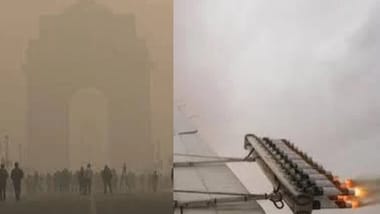
The Delhi government has carried out two cloud-seeding trials near the Indira Gandhi International (IGI) Airport in the past 15 days to assess whether artificial rainfall could help reduce air pollution in the capital, according to PTI citing sources.
The latest attempts follow a project conducted with the Indian Institute of Technology (IIT) Kanpur last year, which failed to generate rainfall despite an expenditure of more than ₹1 crore.
Government sources told PTI that the recent operations were conducted at an altitude of approximately 30,000 metres, compared with nearly 10,000 metres during the trials held in Delhi in 2025. Further attempts are likely after Diwali and Chhath, they said.
The government is unlikely to make an official announcement or confirm the proposed exercises before Diwali.
The Delhi Environment Department signed a Memorandum of Understanding (MoU) with IIT Kanpur on September 25 last year to explore artificial rainfall as a possible measure against pollution.
The project involved two rounds of trials in October. Eight chemical flares containing silver iodide and sodium chloride were released during each operation to encourage precipitation.
However, neither exercise produced rainfall. A subsequent government report attributed the outcome partly to inadequate moisture in the atmosphere, which was estimated at just 10–15%, as per Hindustan Times. Such low moisture levels were not considered favourable for cloud seeding.
The government later claimed that particulate matter levels had declined in some of the targeted areas. However, the primary objective of inducing rainfall remained unachieved. The two sorties cost more than ₹1 crore, according to the project-related information.
is a weather-modification technique that seeks to increase the chances of rainfall or snowfall by introducing substances into existing clouds. Chemicals such as silver iodide and sodium chloride are dispersed into suitable clouds to encourage the formation of water droplets or ice crystals.
These particles provide a surface for moisture to gather or freeze. As the droplets or ice crystals grow, they may become heavy enough to fall as precipitation under favourable atmospheric conditions.
The technique cannot create clouds or generate moisture from scratch. Its effectiveness depends on factors such as cloud composition, moisture content, temperature and prevailing weather conditions.
remained in the ‘very poor’ category for the fourth straight day on Thursday, with forecasts warning that pollution levels could enter the ‘severe’ zone from Friday, just days before Diwali, according to PTI.
The national capital recorded an average Air Quality Index (AQI) of 369 at 4 pm on Thursday, marginally lower than Wednesday’s reading of 377 at the same time, according to the Central Pollution Control Board (CPCB). The average AQI stood at 350 on Tuesday and 324 on Monday.
Data from the CPCB showed that 18 of Delhi’s 59 operational monitoring stations reported ‘severe’ air quality. Jahangirpuri recorded the highest pollution level, with an AQI of 454 at 4 pm.
Under CPCB’s classification, an AQI of 0–50 is considered ‘good’, 51–100 ‘satisfactory’, 101–200 ‘moderate’, 201–300 ‘poor’, 301–400 ‘very poor’ and 401–500 ‘severe’.
The Air Quality Early Warning System (AQEWS) expects pollution levels to remain in the ‘very poor’ category on Thursday before worsening to ‘severe’ between Friday and Sunday.
“The outlook for the subsequent six days is that the air quality is likely to be in the severe to very poor category,” the AQEWS bulletin said.
Meanwhile, forecasts from the Decision Support System (DSS) for Air Quality Management in Delhi suggest that the contribution of stubble burning to the capital’s pollution could decline considerably on November 7, while the share of emissions from vehicles is expected to increase.
The DSS, operated under the Ministry of Earth Sciences, estimated that stubble burning accounted for 15.601% of Delhi’s pollution on Thursday. Its projected contribution is expected to increase to 19.201% on Friday before falling to 1.575% on Saturday.
In contrast, the estimated share of transport emissions is projected to rise from 17.913% on Thursday to 18.291% on Friday and 21.108% on Saturday.
The DSS projections for the contribution of different sources to Delhi’s PM2.5 pollution over the coming days are based on climatological information about fire counts and emissions, rather than real-time data on farm fires.