



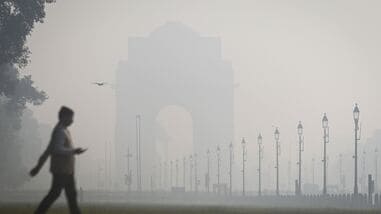
Pollution consciousness is going to spread across the country and will not remain limited to Delhi and neighbouring cities, said Tarun Kapoor, advisor to Prime Minister Narendra Modi in the Prime Minister’s Office (PMO), on Wednesday.
There has been a lot of pollution in and around Delhi, and it is going to spread to other parts of the country. Most north Indian cities routinely see bad air quality during winters, Kapoor said while speaking at the launch of a report by Delhi-based think tank The Energy and Resources Institute (Teri) on India’s multi-fuel pathway towards cleaning up vehicle emissions.
Kapoor said that India’s shift to cleaner fuels away from petrol and diesel is certain, but the availability of new cleaner fuels and their cost will play a major role in deciding the country’s exact strategy, whether it will involve only electric vehicles or also include biofuels and natural gas as a transition fuel.
“Pollution is one large aspect. A lot of debate has happened around Delhi, but then this debate is going to spread to other cities and then other parts of the country,” said Kapoor.
North Indian cities are polluted during winters, Kapoor said. “But it is not just Delhi. If you look at the data, towns in Uttar Pradesh and Madhya Pradesh are also seeing high pollution levels. So, therefore, this pollution consciousness is going to spread.”
Kapoor said that vehicle manufacturers, other equipment manufacturers, and fuel suppliers have to be conscious of widespread pollution and its impact.
He also stressed that uniform decisions regarding India’s clean mobility journey must be taken by all authorities. “Right now, there are Supreme Court directions on reducing Delhi’s air pollution, then we have the road transport ministry, and we have state governments. They all sometimes have policies or thoughts that might be different,” he said.
The Teri study found that no single fuel can be the best choice for an energy transition. “The central finding of this study is that India should not propose one universal fuel choice as the single winner for replacing all the existing mobility choices; rather, it requires a phased transition in which different technologies perform different roles across vehicle fleets, applications, and stages of transition,” the study’s executive summary said.
India’s shift towards cleaner mobility comprises various central government policies, such as incentive schemes for electric vehicle sales and manufacturing, corporate average fuel efficiency norms that incentivise various powertrains, including hybrid and flex-fuel vehicles, and tax benefits for cleaner vehicles.
India, the world’s third-largest automobile market by sales, is also the world’s second-largest electric two-wheeler market, the world’s largest electric three-wheeler market, and the world’s third-largest e-bus market. India’s electric vehicle sales rose 24.6% to 2.45 million units in FY26, from 1.97 million units in the previous fiscal, according to data from the Federation of Automobile Dealers Associations (FADA).