



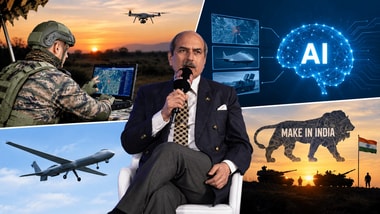
The Indian Army is increasingly turning to artificial intelligence (AI) to process and utilize its vast volumes of data, but its immediate challenge is to organize that information into usable training sets and deploy the right AI models, according to Maj Gen Pawan Anand (Retd), Director, Centre for Emerging Technologies for AtmaNirbhar Bharat (CETANB), United Service Institution of India (USI).
“The Army has moved into AI and is working with a huge amount of data. It is classifying that data and putting it into the right training sets so that it can feed its algorithms and use the right models for field deployment,” Anand told LiveMint in an exclusive interaction on the sidelines of the Defence Tech Summit, which was organized by the Centre for Emerging Technologies at USI.
Anand said the broader push towards AI and digital engineering aims to accelerate the development and deployment of while helping the armed forces keep pace with rapidly evolving technologies.
Digital engineering allows the armed forces to create virtual models of military equipment and test them in simulated battlefield environments before moving to physical prototypes, Anand said.
“ helps us create virtual models of the equipment we want to induct into the military. We can put the physics into these virtual models and test them in a simulated battlefield environment,” he said.
Anand said this approach can reduce development timelines and ensure that physical prototypes are more refined from the outset.
“Digital engineering enables faster ideation, faster development and faster fielding of equipment into the field army. This is essential if we want to keep pace with rapidly changing technologies and maintain an advantage over our adversaries,” he said.
Anand said India’s traditional document-based defence acquisition system, while steady and predictable, can struggle to keep pace with rapidly changing technologies.
“Our aim is to move the entire acquisition process into a much faster plane and ensure that we keep pace with technology,” Anand added.
The has already started adopting digital engineering in some of its projects, although these efforts remain relatively isolated, Anand said. “The next step is to take these efforts to a much wider level across the armed forces,” he added.
Anand identified three key pillars for building effective military AI capabilities: computing power, connectivity and data.
“There are three pillars of AI: compute, connectivity and data,” he said.
He said efforts to build high-compute capabilities had also highlighted gaps in semiconductor capacity.
“When we wanted high compute, we found that we did not have the chips, so we started looking at developing our own chips. Once you have compute, you need connectivity and data as well,” Anand said.
Anand said demonstrated how technological capabilities can provide an operational advantage, while stressing that India would need to continue advancing as adversaries acquire new technologies.
“ demonstrated how better levels of technology can provide us with an operational advantage. The natural progression now is to take that forward, maintain the edge and ensure that we move faster than the pace of technological development and faster than what our adversaries can throw at us,” he said.
Anand also said would learn from the operation and continue acquiring new technologies, including through support from countries such as China and Turkey.
“Pakistan would have also learned lessons and will continue to acquire technologies. The support it has received from China and other developed countries, including Turkey, means that its technological capabilities could also become sharper. That is why we need to maintain our own technological edge,” Anand said.
Anand said the push has helped India localize several capabilities that were previously difficult to develop domestically. “We have begun developing technologies and manufacturing them locally, and that is helping address some of the hollowness that we had witnessed in the armed forces’ equipment earlier,” he said.
However, Anand distinguished self-reliance from complete self-sufficiency, saying India would continue to depend on global supply chains for some capabilities.
“We cannot be completely self-sufficient—nobody else is. Our supply chains will have to depend on somebody or the other, but we have to be self-reliant. We need to ensure that the right supply chains are in place so that Make in India continues to take us towards self-reliance,” Anand said.