


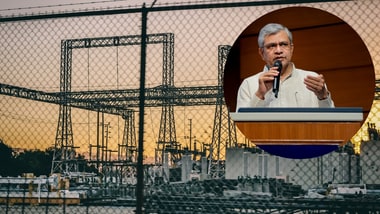
The Union Cabinet has approved the PM-DHARA (PM-Developing Harmonized and Accelerated Renewable-energy Access) Scheme which will help in strengthening India’s Intra-State Transmission System and allow for the evacuation of up to 135 GW of renewable energy across the country.
While announcing the project, minister said, “The country’s current power generation capacity exceeds 500 gigawatts, with renewable energy sources already accounting for 52% of this total…the grid must be designed to manage the load associated with these fluctuations.”
Vaishnaw said that this is the reason countries that have made significant strides in renewable energy have also focussed on grid infrastructure. He cited the desert regions of Ladakh and Rajasthan as holding immense potential to meet this requirement.
The scheme has provided for the deployment of 50 GWh of Battery Energy Storage Systems (BESS) at generator ends or other locations that are crucial for grid flexibility.
The BESS capacity is to address challenges that can arise from the intermittency of renewable energy, congestion of transmission, as well as curtailment at peak hours. This will also help meet electricity demand during the time when solar light is not available.
The government is targetting to implement the scheme starting FY232-33 and the total project outlay for the same will be ₹1,86,405 crore.
Out of this amount, ₹1,36,378 crore will be used for developing Intra-State Transmission Systems under . ₹50,000 crore has been allocated for 50 GWh of Battery Energy Storage Systems.
The total Central Financial Support to be provided for the scheme is ₹54,082 crore, which will help offset the Intra-State transmission charges. The government says this will lower power costs and benefit consumers.
All Greenfield projects under the InSTS component will be implemented through Tariff Based Competitive Bidding (TBCB) mode, while brownfield upgradation and network strengthening works will be executed under Cost Plus Basis (CPB).
The State Transmission Utilities will be the overall implementing agency, and Transmission Service Providers (TSPs) will participate under TBCB on a Build-Own-Operate-Maintain (BOOM) model.
India targets 500 GW energy from non-fossil fuels by 2030.
Vaishnaw also said that India has a target of sourcing around 500 giga-watts of energy from non-fossil-fuel sources by 2030, a goal he believes is achievable.
He said that India has reached a capacity of around 270 gigawatts from non-fossil fuel sources already.
The goal is also to achieve a capacity of 786 gigawatts by 2035–36, Vaishnaw said.
With agency inputs