



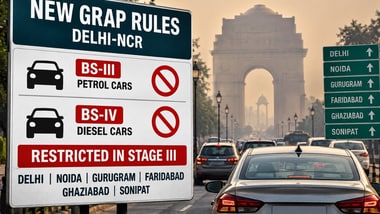
Delhi-NCR’s revised Graded Response Action Plan (GRAP) has tightened restrictions on certain vehicles as the region prepares for annual worsening of air quality during winter months.
The new measures notified by (CAQM) has made many changes from the earlier restrictions. For car owners, however, the question this year is not how old the vehicle is or when it was purchased but the vehicle’s fuel type and BS emission standard.
While there are no restrictions in first two stages of , under Stage III, strict restrictions will apply to BS-III petrol and BS-IV diesel light motor vehicles (LMVs) in Delhi and five NCR districts: Gurugram, Faridabad, Sonipat, Ghaziabad and Gautam Buddha Nagar.
So, as a car owner in Delhi-NCR, what do these new rules mean for you? Here is what you need to know.
The first thing that matters to you is whether you own a petrol variant car or diesel variant.
This matters because the Stage III restrictions specifically target BS-III petrol and BS-IV diesel LMVs. Unlike earlier guidelines, the revised GRAP rules does not impose the same restriction on all petrol and diesel cars.
Therefore, simply owning an older car does not by itself establish whether the vehicle is covered by the Stage III restriction. As owners, you need to check the vehicle’s BS emission standard.
Under the revised GRAP rules, BS-III petrol cars and BS-IV diesel cars fall under the Stage III restriction on light motor vehicles. The restriction not only applies in Delhi but also in Gurugram, Faridabad, Sonipat, Ghaziabad and Gautam Buddha Nagar.
This means that as a car owner you should check the BS category mentioned in the vehicle documents and not assume eligibility purely from the vehicle’s age.
The year of purchase alone does not determine the vehicle’s BS category in the revised GRAP document. According to the CAQM notification, the restrictions apply because of BS emission standard and not by purchase year.
Therefore, the safest way for a car owner to establish whether the vehicle falls under the restriction is to check its BS emission classification in the relevant vehicle documents.
You can also check the information on government’s Parivahan portal. There by following some simple steps you can check your vehicle’s status.
If restrictions under Stage III of GRAP is invoked, the governments in NCR cities and the Delhi government will be required to impose strict restrictions on: BS-III petrol LMVs and BS-IV diesel LMVs.
The restriction applies in Delhi as well as in high-vehicle-density districts of Gurugram, Faridabad, Sonipat, Ghaziabad and Gautam Buddha Nagar.
The revised GRAP document defines Stage III as AQI 401-450. The amended GRAP plan also allows measures to be invoked in advance based on weather and air-quality forecasts.
Yes, depending on the type of vehicle.
For private LMVs, the Stage III provision specifically covers Delhi and the five identified high-vehicle-density districts.
The document separately contains restrictions based on registration for certain goods vehicles. For example, Delhi-registered diesel BS-IV and below-standard medium goods vehicles face restrictions in Delhi, while such vehicles registered outside Delhi will not be permitted to enter Delhi. Diesel BS-IV and below-standard light goods vehicles registered outside Delhi are also barred from entering Delhi under Stage III.
So private car owners should not automatically apply the goods-vehicle rules to their vehicles.
The revised rules specifically include Gautam Buddha Nagar, which covers Noida, along with Gurugram, Faridabad, Sonipat and Ghaziabad in the Stage III restrictions on BS-III petrol and BS-IV diesel LMVs.
So when Stage III is in force and you own one of these vehicles, then you need to take into account restrictions not only in Delhi but also in these specified NCR districts.
The revised GRAP schedule provides for strict restrictions on plying of these vehicles once Stage III is invoked. It does not provide a general exemption simply because the owner needs to travel into Delhi.
Therefore, if you own one of these vehicles then you need to check whether Stage III has been invoked before planning to drive in the restricted areas.
It is also important to remember that GRAP restrictions are cumulative, meaning when a higher stage is invoked, restrictions from the earlier stages continue as well.
There is a specific exemption for persons with disabilities.
The revised GRAP document says BS-III petrol and BS-IV diesel LMVs may be used by persons with disabilities provided the vehicles have been specifically adapted for them and are used only for their personal use.
A valid Pollution Under Control (PUC) certificate is important, but it does not override the separate BS-standard-based restrictions under Stage III.
The revised GRAP plan requires authorities to strictly enforce PUC norms from Stage I, including action against visibly polluting vehicles through impounding and/or penalties. It also calls for enforcement of existing restrictions on overaged petrol and diesel vehicles.
So having a valid PUC should not be interpreted as an exemption from a GRAP restriction that applies to the vehicle’s BS category.
The revised GRAP document calls for strict restrictions and enforcement against vehicles covered by the relevant provisions. It also specifies enforcement agencies including transport authorities and traffic police.
However, it does not specify a separate penalty amount for driving a BS-III petrol or BS-IV diesel LMV in violation of the Stage III restriction.