



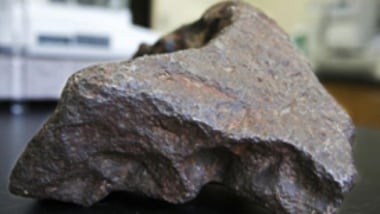
A 10.22-kilogram rock that spent decades holding open a barn door on a Michigan farm has been identified as an iron meteorite from the IIIAB group. The Meteoritical Bulletin reports that the rock was seen falling near Edmore, Michigan, in 1939, and was subsequently recovered on a farm. The official database has now changed the status of the fall of 1939 to doubtful.
It remained on the farm for decades, and the meteorite was used as a doorstop. Following another meteorite impact in nearby Hamburg, Michigan, in early 2018, the subsequent farmer rethought the unusual rock and brought it to Central Michigan University (CMU) in Mount Pleasant for identification.
A sample was then sent to the Smithsonian Institution for further study. This information was recorded in a 2019 research paper to be presented at the 50th Lunar and Planetary Science Conference.
The original finder apparently had the rock in his possession and used it as a barn door stop in 1939, according to the Meteoritical Bulletin. This story was then passed on to the current farm owner, who eventually took the specimen to the CMU after the 2018 meteorite fall in Hamburg sparked interest in finds.
Sirbescu, a professor of geology at Central, identified the rock in October 2018 after the owner brought it to her for analysis, according to a statement from the university. The owner, who had bought the farm in 1988, continued to maintain the strange rock, CMU said.
The Edmore is approximately triangular in shape and is approximately 17 × 20 × 23 cm. The 2019 scientific paper describes it as weighing 10.22 kilograms, with large indentations on its surface and a light-brown fusion crust on parts of its exterior.
A slice was sent to the Smithsonian Institution for identification and classification by the CMU researcher Monaliza Sirbescu. It was analysed with a Nova nanoSEM 600 scanning electron microscope and energy-dispersive X-ray spectroscopy.
The sample was then polished and etched with 10% nitric acid and alcohol. This showed the unique Widmanstätten pattern, which is typical of many iron meteorites. The sample was analysed to detect the presence of kamacite, taenite and schreibersite.
Edmore was found to be a member of the IIIAB iron meteorite group by chemical analysis. The research paper presents data on nickel, cobalt, chromium, iridium, and other trace elements, which aided the classification.
Edmore is recognised as an approved Iron, IIIAB meteorite by the official Meteoritical Bulletin Database. It was found in 1939 and approved on January 1, 2019, with a mass of 10.22 kg. The Smithsonian Institution is also shown as the type locality of the database.
This research was presented at the 50th Lunar and Planetary Science Conference in 2019, labelled as “Edmore, Michigan: A New IIIAB Iron Meteorite”. The authors of the paper are from the Smithsonian Institution, UCLA and Central Michigan University.
The original farm doorstop was discovered and became a scientifically known meteorite. It also illustrates how the identification of meteorites in private collections may be delayed for years, decades, or longer after their initial discovery.