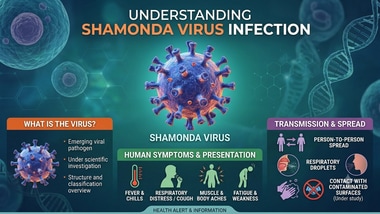
France has reported the first known human case of Shamonda virus in a patient who died, raising questions about its symptoms, transmission and potential risks to people. The virus, which primarily affects livestock, has been detected across more than a dozen European countries this year, decades after it was first identified in Nigeria.
The patient was being treated for a serious illness at a hospital in Lyon and had a severely weakened immune system. French authorities suspect the infection occurred after a bite from an infected midge in eastern France, where the virus had been circulating among livestock.
Investigations into the patient’s infection and death are continuing. The World Health Organization (WHO) has said the case appears to be isolated and is unlikely to lead to wider human transmission based on current evidence.
transmitted by biting midges. It primarily infects cattle, although cases have also been identified in sheep, goats, horses and alpacas.
First detected in cattle in Nigeria in 1965, the virus belongs to the same group as Schmallenberg virus, which is associated with reproductive problems in livestock.
Although Shamonda virus has circulated in parts of Africa and Asia, its detection in Europe this year has drawn attention to its spread among livestock and the uncertainty surrounding its effects.
The first documented involved a patient with a severely weakened immune system who developed brain complications. French authorities said these complications were very likely linked to the infection, although investigations are ongoing.
There is currently limited evidence about Shamonda virus symptoms in humans. One reported case is not enough to establish a complete pattern of symptoms or determine how the infection typically progresses in people.
The WHO has said that, based on available information and knowledge of closely related viruses, the case is unlikely to result in wider spread at this time.
Shamonda virus mainly affects livestock, with symptoms reported in cattle including:
Neurological disorders have also been reported in some horses. The World Organisation for Animal Health (WOAH) has said the long-term effects of the European variants remain uncertain.
After its initial detection in Nigeria in 1965, Shamonda virus was identified in parts of Africa and Asia. It was first detected in Europe in late July this year.
By October 20, cases had been reported in more than a dozen European countries, including France, Germany, Spain and Ireland, all significant cattle-producing nations. French authorities believe the virus may have been circulating in the country since spring.
The virus is transmitted bysuspect the human patient was infected in eastern France.
Current evidence does not indicate that the reported case will lead to wider human transmission. The WHO has described it as an isolated case, drawing on available information and knowledge of related viruses.
However, the limited evidence means the risk to humans is not fully understood. Shamonda virus is not listed as a disease requiring specific notification to the WOAH. It is also not covered by disease-specific mandatory surveillance under the European Union’s Animal Health Law framework.