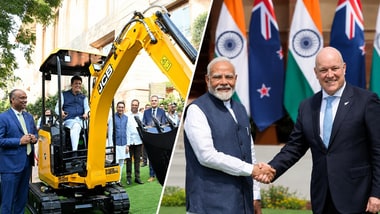
New Zealand will now build with a ‘Made in India’ JCB machine, Commerce and Industry Minister Piyush Goyal said on Monday, announcing the first-ever export of the construction equipment to the island nation from Pune, Maharashtra. The development comes as the India-New Zealand Free Trade Agreement (FTA) is all set to take effect on Vijayadashami. (October 20).
The agreement is set to come into force on Tuesday, October 20, and is expected to open up fresh opportunities for Indian manufacturers and exporters.
“New Zealand will now build with a ‘Made in India’ JCB machine! Proud to flag off the first-ever JCB machine export to New Zealand, made in Pune, Maharashtra,” Goyal said in a post on X.
He added that the trade agreement was creating fresh opportunities for and exports.
The agreement will provide duty-free access for 100% of Indian exports to New Zealand, according to Goyal. The removal of tariffs is expected to improve the competitiveness of Indian goods in the market and create opportunities for businesses across sectors.
“With duty-free access for 100% of Indian exports to New Zealand, the FTA will unlock significant opportunities for MSMEs, farmers, women, youth and labour-intensive sectors,” the minister said.
The agreement is also expected to open new pathways for Indian professionals, while preserving safeguards for sensitive domestic sectors.
In a separate post, Goyal described the agreement as a new chapter in bilateral economic ties, calling it a “Vijay” for both countries.
The removal of import duties is expected to benefit Indian exporters across manufacturing and other sectors.
Engineering goods and automotive products are among the categories expected to gain from improved market access.
The eliminates tariffs on 100% of Indian exports entering, including passenger vehicles and auto components. Select engineering and automotive goods previously faced duties of 5% to 10%, which the agreement is expected to remove.
Goyal also highlighted opportunities for micro, small and medium enterprises (), as well as farmers and labour-intensive industries.
Indian agricultural producers are expected to gain wider market access for fruits, vegetables, spices and other farm produce. The two countries will also cooperate on improving agricultural productivity, supporting higher incomes and strengthening rural livelihoods.
However, the agreement retains protections for sensitive sectors, including dairy, with the government saying farmers’ interests remain a priority.
While Indian exporters receive duty-free access to the New Zealand market, the agreement also provides with tariff elimination or reductions on roughly 95% of its bilateral trade with India.
Immediate duty elimination covers around 30% of tariff lines, including products such as wood, wool and sheep meat.
Tariffs on other eligible products are scheduled to be phased out over three to 10 years.
The agreement is intended to expand trade flows between the two countries while providing businesses with greater certainty and access to each other’s markets.
Beyond trade in goods, the agreement includes ’s commitment to facilitate $20 billion in investment into India.
Goyal said the commitment could help strengthen manufacturing, , services and innovation, while supporting businesses and employment.