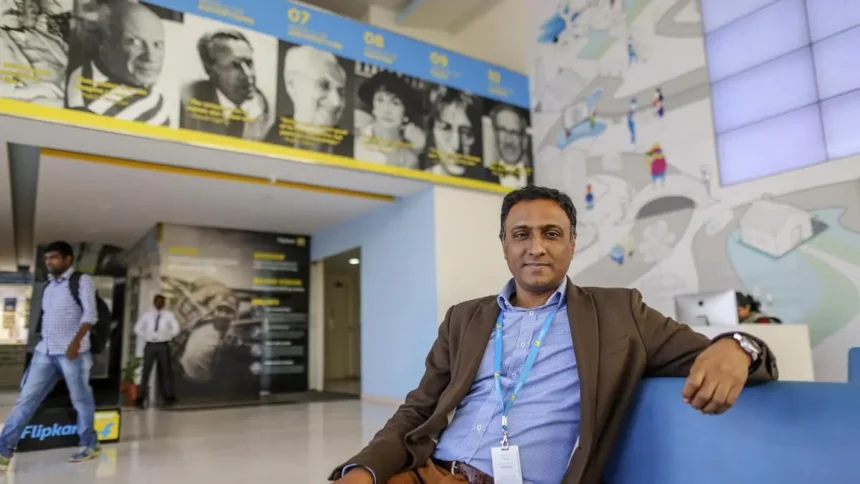
Kalyan Krishnamurthy’s energy is hard to miss. Known for his effervescent personality and an instinct for execution, the outgoing Flipkart CEO has, over the past decade, become synonymous with the ambition and scale of one of India’s largest e-commerce companies.
His journey at the helm, however, has been as much about navigating difficult bets and fierce competition as it has been about building a retail giant.
When Krishnamurthy took charge of Flipkart in January 2017, the company was at a crossroads. Amazon was closing in, investor patience was being tested, and founders Sachin and Binny Bansal were looking for a different kind of leadership to steer the business forward. Nearly a decade later, he leaves behind a much larger company, but one still grappling with the questions of profitability, an IPO and its next phase of growth.
Walmart’s decision to place Krishnamurthy in the top role at Flipkart was an interesting choice, as he was not one of the entrepreneurs who built Flipkart, but someone who knew the company from the other side of the table, having been associated with it through Tiger Global. He brought with him an investor’s understanding of business economics and a sharp focus on execution.
Over the years, he would become one of the most consequential figures in Flipkart’s history.
His first big test was to put the company on a firmer footing and prepare it for its next phase of growth. The Walmart deal in 2018, when the American retail giant acquired a majority stake in Flipkart for $16 billion, was a defining moment. It gave the company financial muscle, provided an exit for its founders and established Flipkart as one of India’s most valuable technology businesses.
Under Krishnamurthy, Flipkart continued to expand its reach and consolidate its position in online retail. The Big Billion Days sale became a major shopping event, drawing millions of customers and sellers. The company also expanded into grocery, digital payments, private labels, and regional-language commerce, aiming to bring online shopping to consumers well beyond the metros.
But building a large business and building a consistently profitable one are two very different things. That distinction has followed Flipkart through much of Krishnamurthy’s tenure.
Not every expansion worked as planned. Flipkart Quick, its attempt to enter the rapidly evolving quick-commerce business, struggled to establish itself against specialised competitors. Some other initiatives also had to be scaled back or reworked. The company had to choose where to deploy its resources as competition intensified and the economics of online retail came under greater scrutiny.
There have also been questions about employee churn, senior-level exits and the long wait for an IPO. For employees who joined Flipkart during its early growth years, a public listing would have provided an important opportunity to unlock the value of their stock options. That milestone has remained elusive.
Financial performance is another unfinished chapter. Flipkart has grown substantially under Krishnamurthy, but significant losses continue to underline the difficulty of turning its enormous scale into sustainable returns. For Walmart, too, the challenge is to show that its sizeable investment can deliver the returns expected from a market as large and competitive as India.
Before joining Flipkart, Krishnamurthy worked at Procter & Gamble and eBay before moving to Tiger Global. This mix of corporate experience, technology exposure, and investor perspective may explain his management approach. He was known more as an execution-focused professional manager than as a public-facing entrepreneur.
His departure marks the end of an important chapter in Flipkart’s evolution. He inherited a company under pressure, helped secure its future through the Walmart deal and oversaw its transformation into a much larger retail platform.
Yet the questions that remain are significant. Can Flipkart find a sustainable path to profitability? Can it finally make its much-anticipated stock market debut? And can it retain the entrepreneurial energy that once made it India’s most closely watched startup?
Krishnamurthy leaves behind a bigger Flipkart. Whether it is also a stronger and more financially resilient one will be the real measure of his legacy.
Published on November 25, 2026