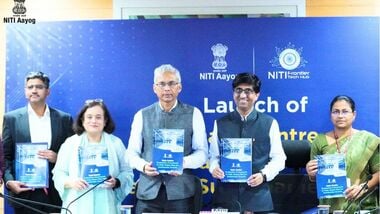
Data centres could account for up to 2% of India’s total electricity consumption over the next decade, compared with around 0.5% currently, as the country expands its digital infrastructure, Member Abhay Karandikar said on Wednesday.
Speaking to ANI on the sidelines of an event to release the Data Centre Set-Up Evaluation Framework Report, Karandikar said electricity demand would rise as data centres expand, but the country has a roadmap to meet the additional requirement.
“Currently, it is about 0.5 per cent of our total electricity consumption. In other countries like the US and Europe, it is much more than that, in the order of 2 to 5 per cent of the total electricity consumption,” he said.
“In the coming years, as the expand in the country, obviously electricity consumption will increase and may reach up to 1 to 2 per cent of the total electricity demand in the coming decade or so,” he added.
The projected increase comes as India expands its digital infrastructure and demand for (AI) and other digital services grows, raising questions about the availability of electricity and water for data centres.
Karandikar said the government was taking steps to increase energy supply through renewable sources and potentially nuclear power in the coming years.
“As the country progresses, electricity demand will increase, but we have a roadmap to meet that demand,” he said.
The growing requirement for electricity is an important consideration for data centre development, given the energy needed to operate servers and maintain the infrastructure that supports digital services.
The newly released Data Centre Set-Up Evaluation Framework Report provides guiding principles and a methodology for assessing data centre proposals, including their electricity and water requirements, Karandikar said.
Water is primarily used to cool servers, although advances in technology could help reduce consumption.
“Advancements are taking place in the technologies also,” he said, adding that the development of efficient cooling systems could create opportunities for Indian technology companies.
The framework comes as policymakers assess the infrastructure requirements associated with expanding data centre capacity.
Major data centres are currently concentrated in Mumbai, Chennai and the Delhi-NCR region. However, Karandikar said future expansion could extend to cities such as Lucknow, Bengaluru, Hyderabad and Pune as states make land, electricity and water available.
The availability of these resources could influence where new facilities are established as India’s digital infrastructure grows.
Separately, Karandikar discussed preparations for sixth-generation (6G) telecommunications. He said some spectrum bands had already been identified, while further decisions at the upcoming World Radiocommunication Conference could help identify additional bands, particularly around 6 GHz.
India has around four years to plan for spectrum requirements expected by 2030, including possible coexistence with existing satellite services, he said.
On the entry of foreign satellite communication companies into India, Karandikar said the issue involved licensing conditions and a broader strategy to expand broadband connectivity while protecting national interests.
He also stressed that developing indigenous technologies did not mean excluding international companies from the Indian market.
“We would like to work and partner with global companies, but at the same time we would like to protect the national interests,” he said.
India already has extensive mobile network coverage, with satellite communications and other technologies expected to complement existing networks, particularly in underserved regions, he added.