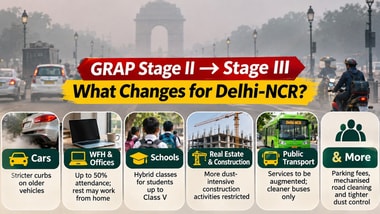
As air pollution worsens in Delhi-NCR, and with the implementation of Stage III of the Graded Response Action Plan (GRAP), certain restrictions have been placed in the area. These are over the above of what was there in Stage I and Stage II.
While is imposed when Delhi’s Air Quality Index (AQI) is between 301 and 400, Stage III comes into force when the AQI enters the ‘Severe’ category, ranging from 401 to 450.
The move to Stage III brings stricter curbs on construction and demolition activities, restrictions on certain categories of vehicles, hybrid classes for younger school students and the possibility of work-from-home arrangements for office employees.
Here’s what changes for you as Delhi-NCR moves from GRAP Stage II to , according to the revised framework issued by the Commission for Air Quality Management () on September 29, 2026.
One of the most important changes under Stage III concerns the movement of private vehicles.
Under Stage III, NCR state governments and the Delhi government are required to impose strict restrictions on the plying of BS-III petrol and BS-IV diesel or older light motor vehicles (LMVs), including four-wheelers.
These restrictions apply in Delhi and the high-vehicle-density districts of Gurugram, Faridabad, Sonipat, Ghaziabad and Gautam Buddha Nagar.
This means owners of BS-III petrol and BS-IV diesel cars, along with vehicles below these emission standards, could face restrictions on using their vehicles in these areas when Stage III is invoked.
There is an exemption for persons with disabilities. They will be permitted to use BS-III petrol and BS-IV diesel LMVs if the vehicles have been specifically adapted for them and are used only for their personal purposes.
The restrictions are to be implemented by the NCR state governments, the Delhi government, transport departments and traffic police.
Stage III also introduces restrictions on certain goods vehicles entering and operating in Delhi.
The Delhi government is required to impose strict restrictions on Delhi-registered diesel-operated BS-IV and older medium goods vehicles (MGVs) within the national capital.
In addition, diesel-operated BS-IV and older medium goods vehicles registered outside Delhi will not be permitted to enter the capital.
The restrictions also extend to diesel-operated BS-IV and older light goods vehicles (LGVs) registered outside Delhi, which will not be allowed to enter the city.
These measures are in addition to the restrictions already applicable under earlier GRAP stages.
Under Stage II, the Delhi government and NCR state governments are required to stagger the timings of public offices and municipal bodies in Delhi, Gurugram, Faridabad, Ghaziabad and Gautam Buddha Nagar.
Stage III introduces the possibility of a more extensive work-from-home arrangement.
The NCR state governments and the Delhi government are required to take a decision on allowing public, municipal and private offices to operate at 50% strength, with the remaining employees working from home.
The provision does not automatically make work from home mandatory for every private-sector employee. It calls for the respective governments to take a decision on implementing the arrangement.
The Central government may separately take an appropriate decision on permitting its employees in Delhi-NCR offices to work from home.
The construction and real estate sectors are among those facing the most significant restrictions under GRAP Stage III.
Under Stage II, authorities are required to intensify inspections to ensure compliance with dust-control measures at construction and demolition sites.
Stage III goes further by imposing strict restrictions on several dust-generating and pollution-causing construction activities across the entire NCR.
However, the restrictions do not amount to a blanket shutdown of every construction activity in the NCR.
Other construction activities that are relatively less polluting or generate less dust can continue, subject to strict compliance with construction and demolition waste management rules and dust-control requirements.
Certain categories of projects are also permitted to continue construction and demolition activities, subject to the prescribed conditions.
School attendance is another major area affected by the transition to Stage III.
Under Stage III, state governments in the NCR and the Delhi government must conduct classes for students up to Class V in a hybrid format.
This means schools must provide both physical and online classes wherever the online mode is feasible.
The provision applies to Delhi and the districts of Gurugram, Faridabad, Ghaziabad and Gautam Buddha Nagar.
Other NCR state governments may also consider introducing hybrid classes for students up to Class V in their respective areas.
Importantly, the option to attend classes online, wherever available, rests with students and their guardians.
Unlike the restrictions on private vehicles and construction activities, Stage III does not introduce a separate new blanket restriction on public transport services in the revised GRAP schedule.
However, measures imposed under earlier stages continue.
The transition to Stage III does not mean that Stage II measures are withdrawn.
Restrictions and measures under earlier stages continue alongside those introduced under the higher stage.
Under Stage II, authorities are required to intensify mechanical and vacuum sweeping of roads, increase water sprinkling with dust suppressants, and take targeted action in identified pollution hotspots.
Parking fees are also to be increased to discourage private transport.
Resident Welfare Associations (RWAs) are required to provide electric heaters, with electricity connections, to security, sanitation, horticulture and other staff to prevent open burning of biomass and municipal solid waste during winter.
The staggered timings of public offices and municipal bodies introduced under Stage II also remain part of the framework.