


India is preparing to significantly expand its ethanol programme, even as producers grapple with a critical question: where will the additional feedstock come from? The government’s renewed push for E100 gained momentum after Union Road Transport and Highways Minister Nitin Gadkari said a Toyota Innova capable of running on 100 per cent ethanol is expected to be launched in October.
These developments bring both the demand and supply sides of India’s ethanol strategy into sharper focus. While the rollout of E20 created a large, assured market by blending ethanol with petrol, a transition toward E85 and E100 would require substantially higher ethanol availability, alongside a broader fleet of vehicles capable of running on higher ethanol blends.
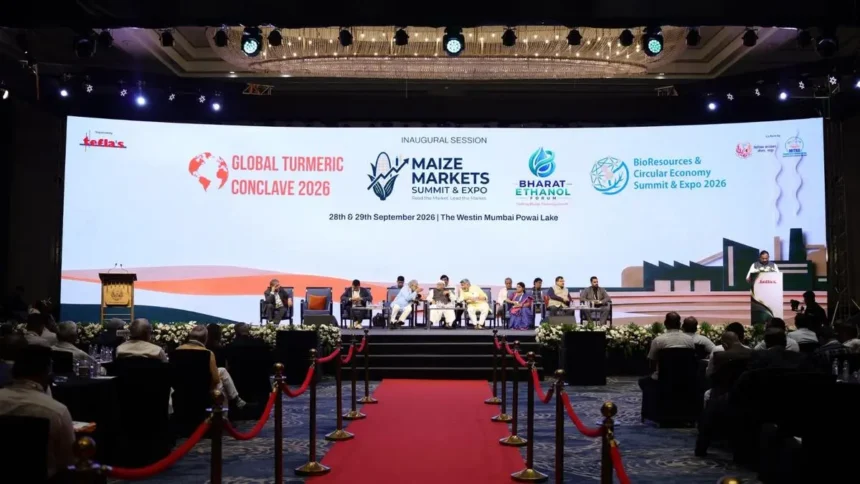
The supply challenge dominated discussions at Tefla’s Bharat Ethanol Forum 2026 and Maize Markets Summit & Expo 2026 in Mumbai, where industry participants stressed the need to diversify ethanol feedstock beyond sugarcane as production capacity expands.
Maize and rice are increasingly emerging as alternative feedstocks, but productivity remains a key constraint. Speakers noted that India’s maize yield averages about 3-4 tonnes per hectare, compared with 11-12 tonnes in the US, highlighting the need for improved seeds, better farming practices, greater mechanisation, and higher investment in agricultural research.
Rajasthan Governor Haribhau Bagde said ethanol can be produced not only from cane juice and molasses but also from maize and agricultural residues. He argued that expanding ethanol production would help reduce India’s dependence on imported crude oil and cushion the economy from geopolitical disruptions and volatility in global energy markets.
Against this backdrop, the expected launch of the Innova E100 brings higher ethanol blends back into the mainstream passenger-vehicle conversation.
The development coincides with a white paper by the All India Distillers’ Association (AIDA) and IIT Delhi, Flex-Fuel Vehicles: Enabling Energy Security and Sustainable Mobility in India, which outlines a 10-point roadmap for accelerating flex-fuel vehicle adoption and gradually moving from E20 toward E85 and E100.
Higher ethanol blends require more than simply dispensing a different fuel. The paper recommends ethanol-compatible components such as FKM (Viton) and PTFE seals, adaptive engine-control-unit calibration, corrosion-resistant materials, and higher-flow fuel injectors to ensure reliable vehicle performance.
Consumer economics may ultimately be the deciding factor. Ethanol has a lower energy density than petrol, meaning pump prices alone do not determine the real cost of driving.
The AIDA-IIT Delhi paper therefore advocates evaluating fuels on a cost-per-kilometre basis and cites an E85 retail price roughly 25 per cent below petrol as an illustrative level at which motorists could achieve parity in running costs.
The study also identifies two-wheelers as a key opportunity for higher ethanol blends, noting that the segment accounts for more than 60 per cent of India’s petrol consumption. Wider adoption in this category could significantly increase ethanol demand.
Policymakers are also linking ethanol to efforts to improve urban air quality. Maharashtra Cooperation Minister Babasaheb Patil cited rising pollution levels in cities such as Delhi and Mumbai while advocating greater use of ethanol and other alternative-fuel vehicles.
The emerging challenge is no longer just about increasing ethanol blending in conventional fuels. Higher-blend vehicles could create a new layer of demand at a time when producers are already seeking additional feedstock sources and higher agricultural productivity.
The Innova E100 will put one side of that equation, a passenger vehicle capable of running entirely on ethanol, firmly in the spotlight. Whether E85 and E100 can scale beyond a handful of models, however, will depend on the availability of feedstock, ethanol production capacity, retail infrastructure, and, ultimately, whether the economics work for motorists.
Published on September 30, 2026