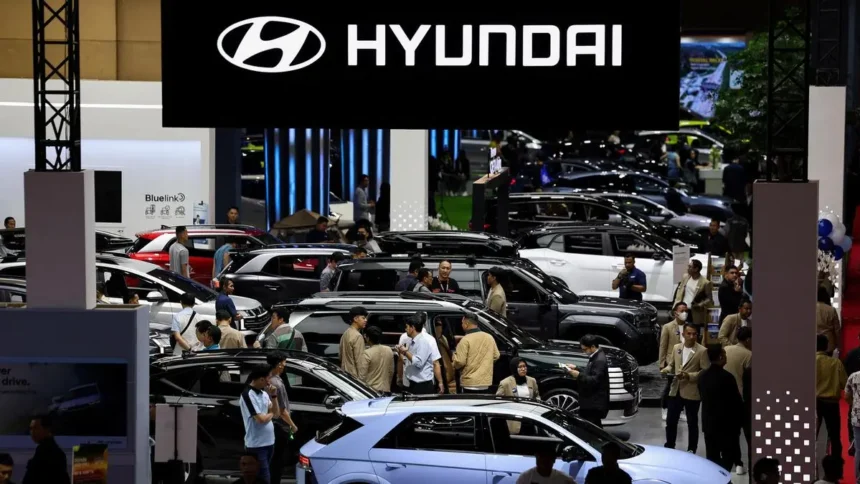
Hyundai Motor India is offering promotional benefits approaching ₹1 lakh on its newly launched Bayon SUV within a month of launch, raising questions over its strategy to regain lost market share and reduce its overdependence on Creta, a single model that accounted for 35 per cent of the carmaker’s domestic wholesales in FY26.
Priced from ₹9.99 lakh, Bayon takes on Maruti Suzuki’s Grand Vitara while competing for buyers of higher-priced Venue and Brezza variants, creating both an opportunity to expand Hyundai’s customer base and a risk of cannibalising its existing SUV sales.
Competitive intelligence gathered from dealerships indicates benefits of up to ₹99,988 on select Bayon automatic variants, effective November 19–December 31, just 24 days after its October 26 launch. Earlier November offers indicated only a ₹5,000 scrappage benefit.
The package comprises ₹65,000 in scrappage support, ₹24,189 in extended warranty, and ₹10,799 in wear-and-tear protection, with no separate cash discount.
Responding to queries from businessline, a Hyundai Motor India spokesperson said, “The benefits being referred to are part of customer-centric programs designed to enhance the overall ownership experience.”
The company did not specifically address the timing of the incentives or disclose bookings, retail deliveries or dealer inventory.
The promotional push comes weeks after Managing Director and Chief Executive Officer Tarun Garg told investors on October 28 that Bayon and an upcoming electric vehicle would “help us to keep the discounts in control”.
Hyundai’s passenger-vehicle retail market share declined to 12.29 per cent in FY26 from 13.48 per cent in FY25, despite registrations increasing to 5,78,337 from 5,61,103, according to the Federation of Automobile Dealers Associations (FADA).
Emkay Global pegged Hyundai’s domestic wholesale market share at 12.4 per cent in Q2 FY27, against 13.4 per cent a year earlier, although it recovered from 11 per cent in the preceding quarter.
The vulnerability arising from Hyundai’s dependence on Creta is becoming increasingly evident. The model’s April–September FY27 dispatches declined 9.7 per cent to 89,727 units from 99,345 a year earlier, partly owing to diesel supply constraints.
Hyundai is targeting combined annual domestic sales of 2.5 lakh Creta and Bayon vehicles, against Creta’s stated annual run rate of around 1.7 lakh, implying an additional 80,000 vehicles.
At 4,245 mm, the Bayon sits above the sub-four-metre Venue and Brezza but below the 4,345-mm Grand Vitara. Its starting price of ₹9,99,900 undercuts Grand Vitara’s ₹10,76,500 by ₹76,600.
Aveek Chattopadhyay, an automotive industry expert, says, “Hyundai needs to reduce its dependence on Creta, but that cannot happen simply by transferring customers from one Hyundai SUV to another. Bayon must attract buyers from competing brands for the diversification strategy to deliver meaningful market-share gains.”
Nomura estimates monthly Bayon volumes of 6,000 units in FY27, while Macquarie factors in around 5,000 net additional monthly units in FY28 after potential Creta cannibalisation.
Other analysts have also questioned Bayon’s market-share recovery potential, while new launches are expected to support a second-half recovery in volumes, margins and market share.
“Each Hyundai SUV has a distinct positioning and customer proposition, helping us cater to diverse mobility needs while continuing to focus on sustainable growth, customer satisfaction and long-term brand strength,” the Hyundai spokesperson said, declining to comment on future volume projections.
Early-November benefits on Grand Vitara petrol variants reached ₹1.36 lakh, and those on Creta petrol variants touched ₹1.10 lakh, although differences in eligibility and validity periods limit direct comparisons.
Hyundai is also promoting Bayon test drives through a ₹1-crore prize campaign until December 31, 2026. The October dispatches of 3,449 units covered only a partial launch month.
Kranthi Bathini, Director–Equity Strategy, WealthMills Securities, also said, “For investors, reducing dependence on a single model is positive, but market-share recovery must also be accompanied by sustainable margins. The market will watch whether Bayon can emerge as an independent growth driver without significantly increasing incentive expenditure or eroding Creta’s profitability.”
Published on November 25, 2026