



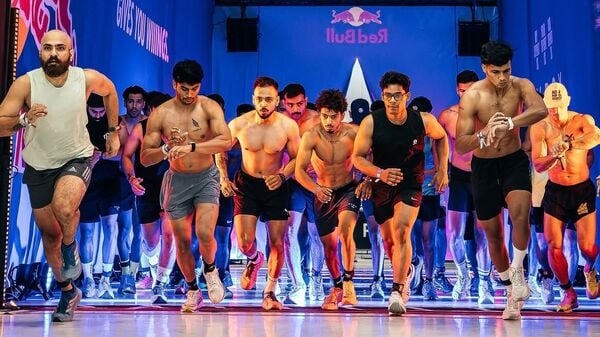
Bengaluru: Sameeha Mariam, 24, spends most evenings running through Adyar in south Chennai. A content creator and now a law student, Mariam began running with her friends three years ago. At the time, she was navigating some professional frustrations; others often got credit for her work and running offered something different. “It was all me. Nobody could attribute it to anyone else,” she said.
Running eventually led her to swimming, cycling, marathons, triathlons and, finally, , a fitness race she has competed in twice, in the mixed-doubles category. The fitness format also changed the content she made, with her videos increasingly focusing on training, runs, workouts and race preparation.
In Mumbai, Varun Duggirala, also a content creator, took up Hyrox almost entirely for health reasons. For the 44-year-old entrepreneur, staying fit had meant lifting weights. Running was never really his thing. After becoming a father, he wanted the strength and endurance to carry his daughter everywhere, walk long distances, lift luggage and pick up a sleeping child without feeling exhausted.
Duggirala signed up for his first Hyrox almost on a whim and trained for 34 weeks. He finished in 2 hours and 14 minutes. “I was never an athlete. That was actually the first competitive sports thing I had done in my life, and I did that at the age of 43,” he said. In the next race, he brought his time down to 2 hours and 4 minutes. In his latest race, he finished in 2:00:45. His daughter was holding the timer that day.
Mariam and Duggirala’s stories offer a glimpse into a broader shift in India’s fitness economy, where consumers are moving beyond the traditional gym for structured, goal-oriented exercise.
Hyrox is emerging as one of the most popular fitness-racing formats in this space, alongside established formats such as , Devil’s Circuit and obstacle-course races, as well as endurance events such as marathons, triathlons and .
These formats cater to different kinds of fitness enthusiasts. CrossFit combines strength, conditioning and functional movements through varied workouts, while Devil’s Circuit and other obstacle-course races test participants through running, climbing, crawling and other physical challenges. Marathons are built primarily around running endurance, while triathlons combine swimming, cycling and running. The Ironman contest takes the triathlon format further, with a 1.9-km swim, 90-km bike ride and a 21.1-km run.
Hyrox sits in the sweet spot between the gym and endurance-sports worlds. Christian Toetzke, Moritz Fürste and Michael Trautmann launched the indoor fitness race, which combines eight 1-km runs with eight intense workouts, in Hamburg, Germany in 2017.
Since then, the event has exploded in popularity all over the world, , where there are more than 500 gyms affiliated with Hyrox today, less than two years since its November 2024 launch, according to the Xinhua news agency.
Globally, Hyrox now has more than 1.5 million participants annually across more than 100 cities in 35-plus countries.
What makes Hyrox appealing is the combination of gym workouts, including sled pushes, rowing and wall balls, with running. It offers a structured goal, and a global benchmark. The format is standardized, with the same distances and loads across cities, allowing someone racing in Bengaluru to compare their time with participants in London or New York and return for another race to see whether they have become faster or stronger.
The intensity of the challenge and the competitive spirit it generates was on full display at Hyrox Beijing last week when Australian athlete Joanna Wietrzyk refused to give up despite suffering severe gastrointestinal distress and went on to win the women’s pro event with a timing of 1:01:23. Her messy path to victory, however, led to a heated debate, prompting Fürste to apologize and promise rule changes.
In India, too, the speed at which Hyrox has grown is striking. Launched only in 2025, the event had a modest beginning with 1,650 participants at its Mumbai debut and 3,350 showing up for the second Mumbai edition.
That headcount more than doubled at the Bengaluru event in April, which saw more than 8,200 participants flock to the arena from more than 170 towns and cities. The subsequent edition in Delhi, a three-day affair held in July, had more than 10,000 athletes taking part. The next race is being held in Mumbai this week, from 17–20 September.
Hyrox entered India through a partnership between Hyrox World GmbH, the global rightsholder, and Bengaluru-based Yoska Technology Solutions Pvt. Ltd, led by chief executive, co-founder and chief coach Deepak Raj. The company is also the franchise owner and strategic partner for Ironman in India. Raj also serves as the country head of Hyrox India.
In India, Hyrox is trying to become more than just a race. While cricket dominates the country’s sports business, individual sports such as badminton, tennis and running have also built commercial properties. Hyrox is attempting to carve out a similar space for fitness racing, building a business around what happens before, during and after the race.
“This is a participative sport. The goal is to make it a spectator sport on par with cricket,” Raj said.
The first challenge for the Yoska team was explaining Hyrox, because awareness was low. The company used footage from international races to promote the event, but Raj sought more—he wanted people to experience the contest rather than simply watching videos.
At a health and fitness expo in Mumbai in 2025, Yoska built a 350-square-metre “Mini Hyrox”. There was no running, but participants moved through scaled-down versions of the functional stations while judges recorded their times. About 500 people showed up. “And we got content,” Raj said.
Indeed, Hyrox is a “very content-friendly sport”. At a marathon, runners and spectators are distributed across a city. Hyrox puts them inside an arena. They can film training sessions, simulations, race-day performances and finishing times. That content attracts more participants, while spectators can eat, shop, interact with sponsors and decide if they want to participate the next time.
Globally, Hyrox generated about €135 million in revenue in 2025 and expects revenue to approach €300 million in 2026, co-founder and chief executive Christian Toetzke told The Economic Times. He estimated that India contributes €4–5 million ( ₹44–55 crore) annually to Hyrox’s global business.
In India, the business operates as a joint venture between Hyrox and Yoska, Raj said. He expects Hyrox to account for around 60% of business this year, with five Hyrox events planned against three Ironman events.
, the investment arm of online brokerage , invested about $460,000 in Yoska in March 2025, giving it an 11.96% stake in the company, according to data platform Tracxn. The investment was part of Yoska’s second funding round, a $511,000 seed round that also included Soonicorn Ventures and angel investors.
In India, Hyrox has four main revenue streams: tickets, sponsorships, merchandise and gym affiliations, said Raj. He added that the Bengaluru event broke even on ticket sales alone.
Hyrox is also building a network of affiliated gyms, using existing fitness facilities to expand its training ecosystem without having to build dedicated centres. These gyms do not need to replicate the full race setup. Instead, they use equipment such as sleds, SkiErgs, rowers, weights and wall balls, along with treadmills or available running space, to offer Hyrox-specific training and simulations.
The affiliation gives gyms access to Hyrox’s training programmes and other resources, while giving members a structured pathway to prepare for the races. Yoska charges an annual franchise fee of about ₹60,000 for its athlete-gym affiliation, according to Saurabh Aggarwal, founder of Hyfit, a hybrid fitness club in Bengaluru and an angel investor in Yoska.
Ticketing remains the backbone. A Hyrox entry in India costs about ₹8,000 before taxes and charges. Participants can compete individually, in Open or Pro categories, or enter doubles and relay formats.
Spectators are becoming part of the story, too. In Bengaluru, nearly 12,000 came to watch, Raj said, while Delhi drew 10,000–15,000 spectators. Tickets for spectators are sold separately, with tickets for the Mumbai event this weekend priced at ₹678, including GST, before service fees.
The first three Hyrox events in India had no title partner, so ticket sales accounted for most of the event revenue, with smaller contributions from an insurance partner and associate sponsors. That is beginning to change, as brands increasingly seek partnerships with the fitness-racing property.
Masters’ Union became a title partner for the Delhi and Mumbai events. “Hyrox is not an obvious partnership for a business school, which is what made it interesting to us,” said Ananya Dengri, brand manager at Masters’ Union. The partnership focused on brand building rather than admissions or lead generation. It also gave Masters’ Union’s student ventures access to a large consumer platform. Startups, including perfume brand Khet and Eat Atlas, showcased products at the event, while more than 40 students worked with the Hyrox team across operations, logistics, sponsorships and participant experience.
Masters’ Union’s strongest activation was a personalized ‘Time Tag’, with about 5,500 tags carrying finishers’ times printed over three days and another 850 being mailed.
Sports nutrition brand ’s chief executive Vijayraghavan Venugopal, whose company has been the energy-drink and hydration partner for multiple running events over the years, said participative sports allow brands to stay with consumers through their fitness journey.
Hyrox sponsorships are now priced at levels comparable to major city-level running events, Venugopal added, with title sponsorships running into a few crores, depending on the Hyrox category and type of sponsorship.
Merchandise is another revenue stream, with Puma selling a dedicated Hyrox range in India. Prices start at ₹3,499 for a graphic T-shirt and go up to ₹21,999 for Hyrox-specific running shoes, according to the sportswear company’s official website.
Hyrox’s initial success has encouraged attempts to create copycats and chase a long tail of fitness spending around the event.
Aggarwal’s Hyfit is trying to build a business that appeals to athletes interested in Hyrox for a shorter period. He converted a 150-year-old rubber factory into a gym, putting a running track around the building so members could train for the event. Hyfit charges ₹10,000 a month or ₹45,000 annually. It has 10–12 trainers and runs around six Hyrox classes a day alongside other programmes. The gym is profitable, Aggarwal said, but keeping members for the long term remains difficult.
CrossFit, another fitness format, has suffered a decline in popularity with Hyrox stealing the limelight. CrossFit is built around strength, endurance, gymnastics, plyometrics (explosive movements that stretch and then rapidly contract muscles to build power) and Olympic lifting.
Ashutosh Bhosle, who has run a CrossFit-affiliated gym in Mumbai since 2015, says Mumbai had around 10 CrossFit affiliates when he started but estimates only three remain. Membership at his own gym is around 25–30% below pre-Covid levels. Consumers now have more choices, including running clubs, swimming, triathlon, Hyrox and other participative sports, he said.
Still, Bhosle is sceptical about Hyrox’s staying power. “Hyrox is a fad,” he said, adding that its standardized format could eventually make it repetitive.
Yoska itself has been experimenting with No Parking, a more accessible fitness-race format aimed at people who find Hyrox intimidating. “The idea came from feedback that Hyrox could look too difficult for people who were not already serious about fitness,” said Dilip Kumar, who leads investments at Yoska backer Rainmatter. For its first edition in Bengaluru, Yoska took the event into a mall parking area, creating a shorter format combining running with functional exercises. About 1,000 people took part.
Hyfit Games is doing something similar. Aggarwal launched the event as a shorter, cheaper version of the Hyrox product. It has held six to seven editions, with recent events in Mumbai and Bengaluru attracting more than 1,500 participants each. Entry costs around ₹2,000 and the course takes roughly 20 minutes to complete.
Yoska is also experimenting with ways to make Hyrox more watchable. Its “Battle of the Gyms” pits mixed-doubles teams representing Hyrox Training Clubs against one another, with gyms competing head-to-head in strength and endurance. Hyrox India has livestreamed the competition on its YouTube channel, using rankings, statistics and graphic overlays to make the action easier for viewers to follow. Kumar said the company is also in talks with Amazon Prime Video to potentially broadcast Hyrox events in India.
This comes as India’s fitness economy expands beyond the traditional gym. Run clubs have mushroomed across cities, while Pilates, swimming, strength training and functional fitness are attracting consumers seeking more social, goal-oriented ways to exercise. New-age businesses such as The Vault and Game Theory are building communities around specific activities, while Cult.fit’s proposed ₹3,500–4,000 crore IPO signals growing commercialisation.
The broader fitness market was worth ₹16,200 crore in 2024 and is projected to reach ₹37,700 crore by 2030, at a compound annual growth rate of 15%, according to Deloitte India and the Health & Fitness Association. Boutique fitness is expected to be the fastest-growing segment, with revenue projected to rise at an 18.8% CAGR to ₹3,100 crore by 2030.
Yet challenges remain. Finding venues is becoming harder, and Raj said India does not yet have enough large indoor spaces to support Hyrox’s ambition of reaching 15 cities.
For now, Hyrox’s growing global calendar gives it an advantage over other fitness-race formats. There are over 100 Hyrox races around the world each year, creating a near-continuous stream of events and social-media content.
Kumar believes the opportunity goes beyond replicating Hyrox, because consumers who have embraced one fitness format are increasingly ready to try the next. “They are ready. They would want something else. And this is a good time to build new fitness and sports formats,” he said.