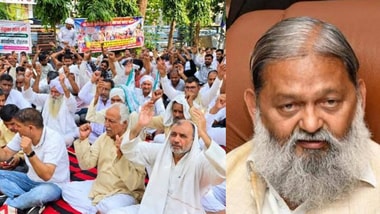
The Haryana government is considering invoking Section 108 of the Electricity Act, 2003, following a demand from electricity employees to revoke the Haryana Electricity Regulatory Commission’s (HERC) order allowing a private company to distribute power in Gurugram and Nuh, Energy Minister Anil Vij said on Friday.
The provision allows state governments to issue written directions to electricity regulatory commissions on policy matters involving public interest. said the government was prepared to explore this option as it sought to resolve the ongoing strike by department employees.
Vij said the government was open to discussions with the employees’ union and was considering its demand to use Section 108 against the HERC order.
“We are ready to hold discussions on all options. This includes taking action under Section 108 of the Act 2003,” Vij stated.
Asked when the issue could be resolved, the minister said the government had been in touch with union representatives and expected the strike to end soon.
“The issue has almost been resolved. I have been telling the employees’ union leaders from the very first day that the strike is not the way ahead to the entire issue. Today also, I have spoken to the employees union leaders. I have told them to come forward and hold talk with the government across the table,” he said.
Vij added, “On Thursday, a demand came from their side that the government should use Section 108 to revoke this (HERC) order, which we can do. And in this regard, I spoke to the Chief Minister. The union leaders have agreed to hold talks with the state government today. I am hopeful that the strike should end within a few hours”.
Chief Minister Nayab Singh Saini and Vij had earlier said the state government stood with the employees and would represent their case before the Appellate Tribunal for Electricity (APTEL) against the HERC order.
Section 108 of the Electricity Act, 2003, empowers state governments to issue written directions to their respective State Electricity Regulatory Commissions on matters of policy involving public interest. The provision requires the regulatory commissions to be guided by such directions while discharging their statutory functions, according to the Electricity Act, 2003, available on the Ministry of Law and Justice’s India Code portal.
In , this provision allows the state government to issue written policy directions to the Haryana Electricity Regulatory Commission (HERC) on electricity-related matters involving public interest.
The provision has two key parts:
1. Section 108(1): The State Electricity Regulatory Commission must be guided by written directions issued by the state government on matters of policy involving public interest.
2. Section 108(2): If a question arises over whether a direction relates to a matter of policy involving public interest, the state government’s decision on the issue is final.
For example, the Haryana government can use Section 108 to issue policy directions to HERC concerning matters such as:
2. Public-interest measures relating to power consumers.
3. Renewable energy and other electricity-sector policy decisions.
4. Policy matters involving wider public implications in the electricity sector.
HERC is expected to take such directions into consideration while performing its statutory functions. However, Section 108 does not give the state government unrestricted authority to dictate every regulatory or tariff decision.
The Haryana Bijli Karamchari and Engineers Joint Sangharsh Morcha called a three-day strike after HERC, on October 19, granted a licence to Eleven Power Pvt Ltd to distribute electricity in Gurugram and Nuh alongside the existing state-owned distribution companies.
Around 40,000 employees joined the protest on Thursday. The strike disrupted electricity supply, water services and industrial activity in several parts of the state, including Gurugram and Chandigarh. Residents in some areas also blocked roads over power outages.
The employees’ union has opposed the entry of a private distributor, arguing that it could make electricity unaffordable for farmers and economically weaker sections in both rural and urban areas.