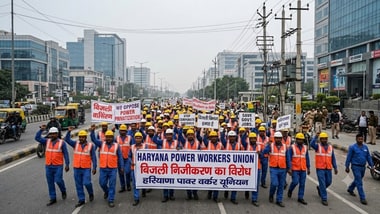
Thousands of households in faced electricity cuts and water shortages on Thursday, while nearly 1,800 manufacturing units reported disruptions as a three-day strike by electricity department employees hit power supply across the city.
The strike, which began affecting supplies on Wednesday night, was called to protest the Haryana Electricity Regulatory Commission’s (HERC) decision to grant a parallel electricity distribution licence to private company Eleven Power for Gurugram and Nuh.
The disruption affected residential neighbourhoods, industrial clusters and rural areas, with residents complaining that electricity officials and helplines had failed to provide timely relief, the reported.
Gurugram, which has around 8.5 lakh electricity consumers, witnessed widespread outages, particularly in Old Gurgaon. Residents said more than 50,000 households in the area were affected on Thursday.
An official said Dakshin Haryana Bijli Vitran Nigam (DHBVN) received more than 3,000 complaints during the first 12 hours of the strike, while its helplines received around 5,000 outage complaints on Thursday.
In Sector 9A, around 6,000 families were affected after power supply stopped at approximately 3.30am on Thursday. The outage also disrupted the area’s water-boosting station, leaving households without water.
“I have called the officials nearly 50 times, but nobody is responding. There is no electricity at our homes. Inverters have run out, and now there is no water either because the boosting station is affected. How are people supposed to manage their daily needs?” Suraj Bhola, general secretary of the Sector 9A RWA, told TOI.
In Hari Nagar, more than 7,000 families were affected after electricity supply stopped around 10pm on Wednesday, residents said. Outages were also reported in Nuh, including Punhana, Nagina and Firozpur Jhirka.
The power crisis affected nearly 1,800 manufacturing units in the Sector 37 and Kadipur industrial areas, with industrial units in Basai also reporting disruptions. Manufacturers said machinery had stopped and production lines had come to a halt, raising concerns about losses running into crores of rupees and delays in deliveries.
Deepak Maini, chairman of the Progressive Federation of Trade and Industry (PFTI), said there had been no electricity supply in Sector 37 since 10pm on Wednesday.
“Power cuts at industrial units have brought machinery and production to a halt, impacting business operations. With operations suspended across hundreds of units, the risk of losses has increased,” Maini said.
Manufacturers attempted to use diesel generator sets, but said these could not sustain continuous industrial operations. The enforcement of the Graded Response Action Plan (GRAP) from Wednesday further complicated the situation, with restrictions on generator sets intended to control air pollution in the National Capital Region.
“A generator is meant for backup, not regular power supply. After running for several hours, it heats up and needs to be switched off to cool down,” industrialist Vikrant Gupta told TOI.
HERC’s October 19 order granted Eleven Power Private Limited a parallel electricity distribution licence for Gurugram and Nuh for 25 years under Section 14 of the Electricity Act, 2003.
The Haryana Bijli Karamchari and Engineers Joint Sangharsh Morcha opposed the decision, arguing that private distribution could threaten public utilities, employee jobs and affordable electricity. According to the unions, around 40,000 electricity department employees across Haryana joined the strike.
The state government has said it will challenge HERC’s order before the Appellate Tribunal for Electricity (APTEL), seeking an immediate stay on its implementation.
Energy minister Anil Vij called the strike unnecessary, arguing that the licensing decision had been taken by the independent regulator rather than the state government. He urged employees to return to work and participate in the legal challenge.
“I am against privatisation because substantial public money has been invested in the infrastructure and employees’ jobs are at stake,” Vij said.
The unions, however, want the licence withdrawn and a clear policy ruling out parallel distribution licences across Haryana. With power supply disrupted across homes and industrial areas, residents and businesses continue to face uncertainty over when normal services will resume.