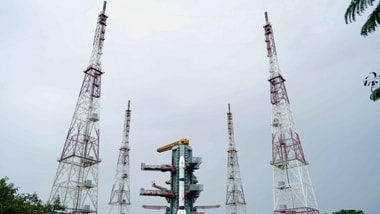
India is set to launch its next-generation navigation satellite, today, Friday, October 30, at 11:51 pm IST, in a mission aimed at strengthening the country’s indigenous satellite navigation capabilities.
The launch from Sriharikota will be the GSLV rocket’s 20th flight and marks another attempt by India to strengthen its own satellite navigation system, NavIC, which helps people and services determine their location and track time accurately.
The launch comes at a challenging time for NavIC, as several of its existing satellites have stopped working properly, while attempts to replace them have also faced setbacks.
The has scheduled the GSLV-F18/NVS-03 mission for October 30, 2026, at 11:51 pm Indian Standard Time.
The 51.7-metre-tall GSLV Mk II rocket will lift off from the Second Launch Pad at the Satish Dhawan Space Centre, Sriharikota.
Its primary task will be to place the 2,232 kg NVS-03 satellite into a Geosynchronous Transfer Orbit (GTO).
Space enthusiasts can follow the launch through ISRO’s official digital platforms.
Viewers should check ISRO’s official website and for the live broadcast and mission updates.
NVS-03 is the third satellite in ISRO’s new-generation NavIC programme, which aims to improve and strengthen India’s home-grown navigation system.
The satellite will carry an Indian-made atomic clock along with other clocks sourced from outside the country. It will also introduce support for an additional signal, which could help more smartphones and navigation devices use NavIC.
With these improvements, India hopes to make its navigation system more reliable and useful for everyday needs. NavIC is designed to cover the whole of India and areas extending up to 1,500 km beyond its borders.
Atomic clocks play a crucial role in helping navigation satellites pinpoint locations accurately. Even a tiny error in timekeeping can affect how accurately a phone or other device identifies where someone is.
By developing its own atomic clocks, ISRO hopes to rely less on imported technology and give India greater control over its satellite navigation system.
NVS-03 will also support an additional signal, known as the L1 band, alongside the existing signals. This is expected to make NavIC more compatible with smartphones and other navigation devices, while allowing it to work more effectively alongside systems such as the US-based GPS.
NavIC has been facing several problems in recent years, with a number of its older satellites developing faults or becoming unusable. Some stopped working because of failures in their onboard clocks, while others could not reach the right orbit.
The system suffered another setback in January 2025, when ‘s NVS-02 satellite failed to move into its intended orbit because of a problem with its thrusters. As a result, it could not begin providing navigation services as planned.
The situation became more difficult in March 2026, when the last working atomic clock aboard another satellite, IRNSS-1F, also stopped functioning. This left NavIC with only three satellites capable of supporting navigation services, fewer than the four needed for the system to work fully.
ISRO is now looking to rebuild the network with NVS-03, followed by two more satellites, NVS-04 and NVS-05. Together, these launches are expected to help make India’s navigation system more reliable.
ISRO has also made changes to avoid a repeat of the problem that affected NVS-02. For the new mission, the space agency has decided to keep certain valves open before launch to prevent a similar technical fault from occurring.
The successful launch of would be an important step towards making India’s own navigation system stronger and more dependable. It could also reduce the country’s reliance on foreign systems such as GPS, which are widely used for navigation and other essential services, including banking, transport and telecommunications.