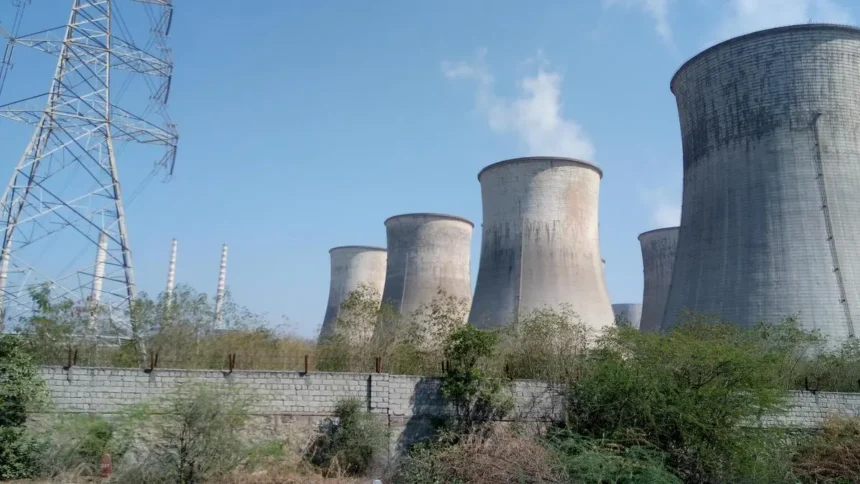
The Power Ministry has issued an advisory to State governments for aligning commissioning of thermal power plants (TPPs) with transmission, fuel supply, storage and grid support as it aims for timely and dependable capacity addition.
The integrated planning for commissioning and scheduling is related to long-term procurement of power by Discoms from power stations established on a Design, Build, Finance, Own and Operate (DBFOO) basis.
The Ministry observed that delivery schedules and commissioning timelines stipulated by several procurers and Discoms in their recent bids are not aligned with the respective Resource Adequacy Plans of States or are difficult to achieve in view of the prevailing domestic manufacturing lead times and constraints relating to Boiler, Turbine and Generator (BTG) equipment.
“States & Discoms are hereby advised that delivery schedules and commissioning timelines for all long-term power procurements under the DBFOO mode may be aligned with their respective Resource Adequacy Plans. However, a realistic construction and commissioning period, preferably not less than 60 months from the Appointed Date must be prescribed, keeping in view the manufacturing capacity and supply chain constraints of major equipment such as BTGs,” it added.
Welcoming the development, Vivek Agarwal, Director-Energy Consulting at Nangia & Co LLP, noted that the aim is timely, dependable capacity — not simply more installed megawatts (MW).
“Commissioning too late leaves a supply gap; procuring too early or in excess can burden consumers with fixed costs. Coordinated delivery is the route to reliable, stable, and affordable power,” he told businessline.
The priority is to turn planned thermal capacity into dependable power by aligning plant commissioning with transmission, fuel supply, storage and grid support, he added.
The recommended period of at least 60 months from the appointed date provides a reasonable planning benchmark (till the supply-chain issues persist), especially for a new, large 660 or 800 MW supercritical or ultra-supercritical plant. Delivery will depend on project-specific readiness, but this is not a universal construction norm, Agarwal explained.
He pointed out that execution remains a constraint. For instance, India added roughly 9.47 gigawatt (GW) thermal capacity in FY26 against a 12.86 GW target.
“Telangana illustrates why timing matters. Discoms cited a contracted thermal requirement of 15,893 MW by 2029–30 against existing capacity of around 9,791 MW. Proposed additions from Yadadri, Singareni Stage II, and NTPC’s Telangana station must be matched to that requirement. The Central Electricity Authority’s (CEA) report anticipated Singareni Stage II’s trial run in December 2028; a trial run, however, is not the same as commercial availability,” Agarwal emphasized.
The TPPs will also need to support renewable energy integration through flexibility, ramping and balancing. Moving from a minimum technical load of around 55 per cent across much of the existing fleet towards the CEA’s 40 per cent target by 2030 will require plant-specific upgrades, operational changes, and compensation for flexibility costs, he added.
Equipment supply, land acquisition, EPC, and balance-of-plant readiness all need to inform procurement schedules, including the time between award and the appointed date.
“A practical next step is a common Resource Adequacy-to-Commissioning Matrix, led by the Ministry and CEA with CTUIL and GRID-INDIA. Updated annually with State plans, it should match dependable capacity needs to realistic commercial operation dates and project confidence levels. Milestones should cover equipment, EPC, finance, land and clearances, fuel and water, transmission, storage, and grid support,” Agarwal suggested.
Any interim shortfall should be addressed through a suitable mix of existing generation, storage, hydro, renewable procurement, demand response, and market purchases. Wherever technically feasible, competitive, technology-neutral procurement should value dependable capacity and flexibility alongside energy, including reserves, ramping and reactive support, he added.
Published on November 12, 2026