



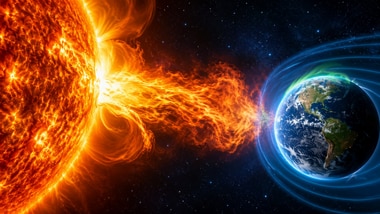
The Sun has released a powerful burst of energy and solar material that could reach Earth around 11 October, potentially triggering a storm.
Scientists are monitoring the incoming material for its possible effects on satellites, and navigation systems, although the extent of any disruption remains uncertain.
According to the US National Oceanic and Atmospheric Administration (NOAA), a geomagnetic storm watch has been issued for 11 October, with a moderate G2-level storm considered likely. The forecast follows two coronal mass ejections (CMEs) released by the Sun on 7 and 8 October.
The 8 October eruption was associated with an M6.7-class solar flare originating from sunspot region 4549. ‘s Space Weather Prediction Center said the two clouds of solar material could merge while travelling towards Earth, potentially influencing the resulting geomagnetic activity.
Solar flares are sudden bursts of energy released by the Sun. Coronal mass ejections, meanwhile, involve enormous clouds of charged particles and being expelled into space. When these clouds reach Earth, they can interact with the planet’s magnetic field and trigger geomagnetic storms.
The two phenomena are related but not identical. A solar flare’s radiation can reach Earth in minutes, while a CME typically takes much longer to travel across space. Its effects depend on its speed, direction and magnetic properties.
According to NOAA, the incoming solar material could disturb Earth’s magnetic environment. However, a storm watch is a forecast rather than confirmation that significant will occur.
One possible outcome is an enhanced display of , commonly known as the northern and southern lights. These colourful displays form when charged particles interact with gases in Earth’s upper atmosphere.
During geomagnetic storms, auroras can become brighter and appear farther from the polar regions than usual, depending on the storm’s strength.
There could also be technological effects. Geomagnetic activity can interfere with high-frequency radio communications, affect satellite operations and reduce the accuracy of satellite-based navigation systems.
Stronger storms can induce electrical currents in power transmission networks, potentially creating operational challenges for electricity providers.
NASA’s Community Coordinated Modeling Center has also published forecasts for the 8 October coronal mass ejection, estimating a possible arrival late on 11 October, with some uncertainty around the timing.
For now, there is no reason for widespread public alarm. Earth’s atmosphere and magnetic field provide substantial protection from the harmful effects of solar activity. The main concerns during geomagnetic storms involve technology and , particularly if conditions become stronger than expected.
Scientists will continue monitoring solar observations and the incoming material to determine whether the predicted storm develops and how intense it becomes.