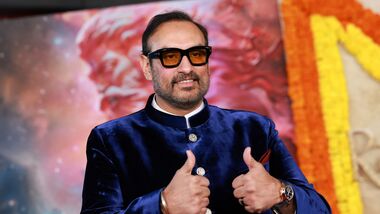
Before taking on the reported ₹4,000 crore investment behind , producer had already built an international business in the visual-effects industry. His journey began with a small venture in a Mumbai garage, went through a major financial setback during the 2008 global recession and eventually led to the creation of an Oscar-winning visual-effects company.
With Ramayana Part 1 scheduled to release in theatres on November 5, the scale of the ambitious two-part adaptation has brought renewed attention to Malhotra’s business journey. Directed by , the film stars Ranbir Kapoor, Sai Pallavi and Yash in lead roles.
From establishing a video-editing and computer-graphics venture to expanding into international markets and collaborating with leading filmmakers, Malhotra’s career has spanned entrepreneurship, visual effects and film production.
Ahead of the film’s release, the makers hosted a special presentation at the Academy Theater in Los Angeles. Addressing the audience, Malhotra described the occasion as his personal Oscar moment.
He highlighted the achievements of his company, DNEG, and its team, which have won eight Academy Awards, with seven of those wins coming in the last 11 years for visual effects.
Malhotra also acknowledged the opportunity to work with some of the biggest names in international cinema, including Christopher Nolan and Denis Villeneuve.
Recalling his entrepreneurial beginnings, the producer spoke about starting a business at the age of 19 with an Apple computer in a Mumbai garage.
“For a third-generation film family background, and a garage startup kid at 19 with an Apple computer working with three of his teachers who were all of 21. This is what dreams are made of and what better place to share this moment than the city of dreams – Los Angeles.”
Malhotra’s entrepreneurial journey began with a small video-editing and computer-graphics venture. According to a report by The Indian Express, he merged the business with his father’s equipment-rental company in 1997 to establish Prime Focus Limited.
The company gradually expanded its operations and became a significant player in post-production and visual effects.
However, its international expansion came with financial challenges. Speaking at the Los Angeles presentation, Malhotra recalled losing 90% of his wealth during the 2008 recession.
“In my pursuit of building a global company and connecting the East and the West, I set foot in LA in 2007 and haven’t looked back since. An immigrant, who lost 90% of his wealth with the fun times in 2008, as I am sure some of you may remember, to bounce back today and being able to bring the biggest independent production in the world… I can’t even tell you what it feels like to stand here today and say this. We have been able to bring together some of the absolute best talent from India, as you all have seen, and have collaborated with some of the finest Western talent,” he said.
Moving to the US as an immigrant and navigating the financial crisis made the journey particularly challenging. Malhotra eventually rebuilt his business, bringing together Indian and international talent for large-scale productions.
He also expressed gratitude to those who supported him throughout his journey, including his parents, Nita and Naresh Malhotra, and his wife.
Malhotra credited his filmmaker father with encouraging him to begin his career in production. He explained that his entry into post-production and visual effects was driven by a longer-term ambition to make films.
A significant milestone in Malhotra’s business journey came in 2014, when Prime Focus merged with London-based visual-effects studio Double Negative.
The combined company was subsequently rebranded as DNEG, which went on to win eight Academy Awards for its work on international films.
The merger marked an important step in the company’s international expansion, bringing together its Indian operations and the expertise of a London-based visual-effects studio.
DNEG’s work on major international productions, including projects associated with filmmakers such as Christopher Nolan and Denis Villeneuve, helped establish its presence in the global visual-effects industry.
The company’s eight Academy Awards have also become an important part of Malhotra’s professional journey, which has now extended beyond post-production and visual effects into large-scale film production.
Malhotra’s latest venture is Ramayana, a two-part cinematic adaptation of the Indian epic, directed by Nitesh Tiwari and co-produced by actor Yash.
The ambitious project has a reported combined budget of ₹4,000 crore, making it one of the largest-scale Indian film productions.
Ranbir Kapoor plays Lord Rama, while Sai Pallavi essays Sita and Yash portrays Ravana.
The ensemble cast also includes Ravi Dubey, Rakul Preet Singh, Vivek Oberoi, Lara Dutta and Arun Govil in important roles.
Ramayana Part 1 is scheduled for a worldwide theatrical release on November 5 in multiple languages.
For Malhotra, the project represents another step in a career that began with a small computer-graphics venture in Mumbai and expanded into building a global visual-effects business before moving into large-scale filmmaking.