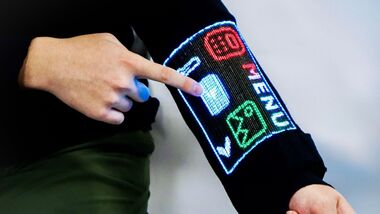
Ever wondered if your clothes could do more than just keep you warm? Researchers at the National University of Singapore have developed a sleeve that lets you perform tasks you would normally reach for your phone to do.
According to NUS, the sleeve was created by scientists at the university’s College of Design and Engineering (CDE) and consists of electronic fibres that display images and detect touch. By incorporating 54 of these fibres into a sleeve, the team says it has made the world’s first touchscreen built into clothing.
Additionally, the sleeve can show images and videos, respond to taps, and connect wirelessly to other devices. It remains washable, breathable, and flexible, allowing users to interact with and view health information through their clothing without a rigid screen.
According to the findings, the sleeve can perform simple tasks familiar from early , including running a calculator, displaying photos, playing videos, acting as a compass, and responding to voice commands. Additionally, it can receive images via Bluetooth and automatically adjust the screen’s orientation and brightness. Further, after placing a temperature sensor under the arm, the team found that the sleeve could measure and display the reading.
Phone and laptop screens use flat, rigid panels to display information and respond to users. Fabric, made from individual fibres, has not offered the same capability, according to the findings. The researchers’ work makes it possible to build a full-colour touchscreen using electronic fibres that can be worked into clothing like ordinary yarn.
The team behind the sleeve was led by Tural Khudiyev, an assistant professor in CDE’s Department of Materials Science and Engineering. The researchers published their findings on Wednesday. Commenting on the development, Khudiyev said, “What made this possible was our ability to construct the GUI system from electronic building blocks in fibre form — similar to traditional yarn, but with the sophisticated electronic functionality built directly into the fibres.”
To build a fibre-enabled garment display, the team used a laser to expose small sections of insulated wires where microchips needed to connect. They then used melted solder to join the components at those points and linked over 5,000 chips through over 20,000 electrical connections.
The connected were built into a layered fibre using a process that heats and draws materials into thin threads. The resulting fibre was just one millimetre thick and 10 metres long. A touch-sensitive layer beneath the LEDs detects where the fibre is pressed and lights up the nearest pixel.
The researchers built the screen into the forearm of a sleeve using 54 electronic fibres, each containing 96 tiny LED lights. The display measures 168 mm by 105 mm and can detect several touches at once. Each fibre works independently, so if one stops working, the others can continue to function.
They also added a microphone, a speaker, and sensors that detect movement, direction, temperature, and surrounding light.
Despite the electronics, the sleeve remains flexible and breathable. Its brightness and touch response changed very little after 50 machine washes with detergent and 1,000 tight bends. The researchers also found that the display was as breathable as cotton, polyester, and denim, and met established safety limits for contact with skin.
The team now plans to improve the screen’s resolution, add more sensors, and bring (AI) into the fabric itself. These advances could eventually allow clothing to monitor the wearer and their surroundings, offering useful information and assistance when needed.