



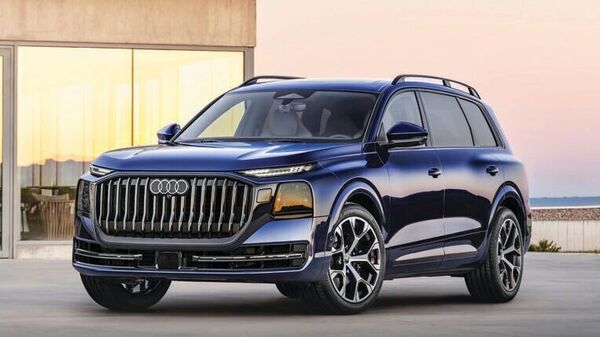
An Audi Q9.
BMW, Audi and other European carmakers are trying to revive their sales with a new generation of supersized luxury SUVs in America.
BMW is looking to make a supersized sport-utility vehicle specifically for the U.S., it told investors in Munich this week. Volvo Cars has said it would introduce a larger SUV in the U.S. as part of a major portfolio revamp. And Audi recently launched the Q9, its first full-size SUV, on the roof of a New York hotel.
“Americans love big SUVs. So why don’t we listen to that?” Volvo Cars Chief Executive Håkan Samuelsson said in an interview.
European automakers are hungry for growth after a sales collapse in China triggered by falling home prices and digitally savvy local competitors. China used to account for as much as half of profit for companies such as BMW, Mercedes-Benz and Audi owner Volkswagen.
The business case for launching larger SUVs in the U.S. has grown even stronger after President Trump eased emissions standards. Under new rules, automakers no longer need to sell as many fuel-efficient cars to compensate for big SUVs, which typically come with big, gas-guzzling engines.
As profit from China has dried up, the U.S. has taken on outsize importance. Big SUVs are a particularly attractive niche to grow into because they carry higher margins.
“Typically in the auto industry, the bigger the vehicle, the bigger the profits,” said Tyson Jominy, a senior vice president at data provider J.D. Power.
Detroit dominates the big-SUV category today, including luxury models. Shares of General Motors—maker of the Cadillac Escalade, by far America’s bestselling full-size luxury SUV—have traded at postbankruptcy records since Trump came to office with promises to cut electric-vehicle incentives and emissions regulations.
European automakers, with their share prices trading at multiyear lows, are getting in on some of the action.
Audi’s new Q9 is around 209 inches long, approaching the dimensions of the Cadillac Escalade (about 212 inches). While the $87,700 standard Q9 is powered by a three-liter V6 engine, a special $118,000 “SQ9” aimed even more squarely at North America uses a four-liter V8.
“The American buyer in this space will expect the most engine they can get,” said Jominy.
Audi, which doesn’t have a U.S. factory, is making the Q9 in Slovakia. Vehicle imports from the European Union incur a 15% tariff imposed by Trump. Deliveries start in November.
Details of the new SUVs in the works at Volvo and BMW are scant, but both companies have factories in South Carolina that would make natural homes for their biggest SUVs.
BMW’s plant in Spartanburg is running at full tilt. The company is likely to shift production of some of its smaller X5 SUV to Europe to make space for the new model, according to a person familiar with its planning. Making each region more self-sufficient would also cut tariff costs.
Unlike the BMW plant, Volvo’s factory near Charleston has lots of spare capacity that the Swedish company is eager to fill. “We put a lot of bets on building EVs, which has shown to be giving the factory too little volume. We need to build other cars in the factory,” said Samuelsson.
While Europe’s luxury brands appear to be targeting the same market as the Cadillac Escalade and Ford Motor’s Lincoln Navigator, the new models are expected to have a different feel.
The Cadillac and Navigator adopt the traditional body-on-frame approach also used in pickup trucks, where the cabin is bolted onto a separate chassis. European carmakers specialize in “unibody” designs, where the body and frame are built as one unit. Unibodies typically perform better on fuel economy and road handling, whereas body-on-frame models are typically used for off-roading and towing.
The exception could be the Volkswagen brand itself, which is likely to build body-on-frame models such as a pickup truck and big SUV for the U.S. market, according to people familiar with its planning. The company is currently debating whether to partner with another automaker that already uses body-on-frame designs—an approach that would get vehicles in showrooms sooner—or work with North American suppliers to build one itself.
The focus on big SUVs, a style of vehicle rarely seen in Europe, is part of a broader strategic shift under way at European carmakers toward a more regional approach.
Luxury brands in particular used to try to sell the same cars globally. Now higher tariffs, local-content rules, diverging emissions standards and different consumer tastes are pushing them to bring out more vehicles tailored to the needs of their biggest markets.
“The Americans and Chinese have increasingly different ideas about what a luxury vehicle is,” said Simon Schnurrer, global head of automotive at consultant Oliver Wyman.
Write to Stephen Wilmot at [email protected]