



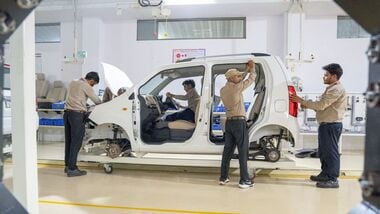
After more than a year of tussle between Maruti Suzuki and rivals such as Tata Motors Passenger Vehicles over relief for small cars, the government has finalized the Corporate Average Fuel Efficiency (Cafe) 3 formula, giving lighter vehicles more emissions headroom.
The final norms, which aim to reduce average emissions from a carmaker’s fleet, were notified late on Tuesday night and will apply from 1 April 2027 to 31 March 2032. The notification by the Ministry of Power gives carmakers roughly six months to finalize their plans to meet the requirements.
The government has eased the overall Cafe 3 targets while tilting the relief more towards lighter cars. The targets set for each year allow smaller vehicles more headroom on emissions compared with previous drafts.
The final Cafe 3 rules ease the emission targets for cars overall by around 7-10%, but the relief is much greater for small cars. Rough calculations by Mint for FY28, compared with the September 2025 draft, showed that the permitted CO2 emissions for a 909 kg car rise by about 9%, while the increase for a 1,500 kg car is less than 1%.
The difference becomes much bigger by FY32. For a 909 kg car, the final rules allow nearly 17% more CO2 emissions than the , while the increase for a 1,500 kg car is just 0.2%. Put simply, the government has flattened the formula over time, giving smaller cars a much larger share of the overall relaxation.
The relief would come as a breather for Maruti Suzuki, which had warned last year that tighter targets for small cars would put them at a disadvantage, as the room to reduce carbon emissions is much smaller in small cars.
This comes at a time when small car sales are surging in the Indian market. Between April and August, sales of mini cars such as Alto and S-Presso nearly doubled to 65,190 units from 33,197 units in the year-ago period, data from the Society of Indian Automobile Manufacturers showed.
Introduced for the first time in 2015, the country’s Cafe norms have seen two iterations, which ran from 2017 to 2022 and 2022 to 2027. The next leg is set to begin from April 2027 and is being seen as the strictest iteration of Cafe norms, requiring carmakers to introduce cleaner cars, ranging from EVs, CNG and hybrids.
Differences between Maruti and other carmakers arose over a separate 3g relaxation for cars under 909 kg in the September 2025 draft. This special carve-out has been removed, and instead the government has chosen to relax overall targets for lighter cars.
, Maruti’s managing director and chief executive Hisashi Takeuchi had written a letter to Tata Motors PV MD and CEO Shailesh Chandra, invoking late Ratan Tata.
“Great global leaders like Mr Ratan Tata and Mr O. Suzuki have always felt the pain of two-wheeler owners and their families trying to afford an entry-level car,” Takeuchi said in the letter addressed to Chandra, reported by Mint on 7 November.
“Unfortunately, the more efforts our designers undertake in improving the fuel efficiency of the car through light-weighting, the tougher the Cafe target becomes,” the letter had said.
The tussle came into the public light after Tata Motors PV Chandra opposed it during a post-earnings press conference on 14 November.
“We do not support any move to include weight in the definition of small car. Such an arbitrary criteria would conflict with one of the country’s most critical imperative that is safety,” Tata Motors’ Chandra said.
The Cafe 3 norms notified to also introduce a system for from the government to help meet their targets. Companies will have to maintain a passbook for their compliance, with outperforming targets giving them credits while underperformance giving them debits. At the time of assessment, a carmaker’s passbook must have a positive credit balance to avoid a penalty.
An option to buy credits directly from the regulator has been seen as one of the easier routes for compliance for firms that have debits in their balance owing to missing set targets.
To be clear, carmakers are allowed to purchase credits from peers and competitors to meet fuel-efficiency targets in other countries also, but the proposal to purchase credits from the regulator itself is unprecedented.
Other relief measures include supercredits. Primary among the changes was a tweak in the ‘supercredit’ style of incentives for clean vehicles.
Supercredits—accounting multipliers that allow cleaner vehicles to count as more than one vehicle for compliance purposes—were cut to 1.1 for flex-fuel vehicles from 1.5 in the previous draft. Flex-fuel vehicles can run on any mix of petrol and ethanol. Supercredits for strong hybrid cars were also reduced to 1.6 from 2.
Supercredits for other vehicle categories remain unchanged, including for electric vehicles at 3, meaning every electric car would be counted as three cars.