



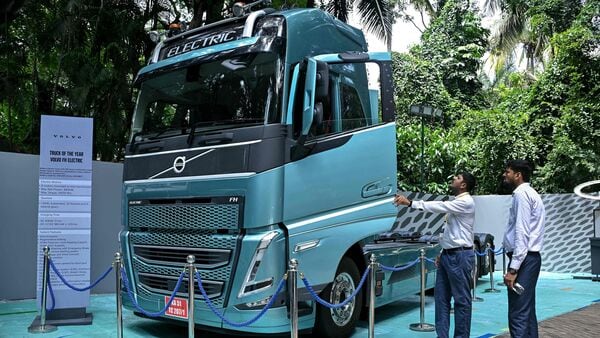
New Delhi: Indian manufacturers of electric trucks and electric buses may seek another extension of exemption from localization rules under the ₹10,900 crore scheme due to the continuing unavailability of locally made rare earth magnets, according to two people aware of the development and a document reviewed by Mint.
If granted, the exemption would be the third such waiver since localization rules were announced in March 2025. However, China halted the supply of these magnets in April 2025 in retaliation for , disrupting the manufacturers’ plans because they could not claim incentives on importing sub-assemblies of these magnet-laden motors, as allowed in the original localization rules.
Six-month extensions were granted in September 2025 and March 2026 and with limited imports allowed by China and local rare earth magnets still unavailable, manufacturers may seek another extension.
and e-truck makers, as part of the Society of Indian Automobile Manufacturers (Siam), discussed the issue on 23 July, according to the document containing the agenda of the meeting for Siam’s electric mobility group.
“Discussions have begun within the industry for this exemption, but no final decision has been taken yet,” an auto industry executive said, requesting anonymity.
Queries emailed to the ministry of heavy industries, Siam and electric truck and bus manufacturers Tata Motors, EKA Mobility, PMI Electro, Switch Mobility, JBM Group, Montra Electric and Volvo Eicher Commercial Vehicles on 27 July remained unanswered.
In November 2025, India announced a ₹7,280 crore incentive programme to build 6,000 tonnes per annum of indigenous rare earth magnet making capacity. However, the government has continued to extend the tender closing date under this scheme owing to low interest, Mint reported on 26 June.
While electric two- and three-wheeler manufacturers can use alternative light rare earth magnets or magnet-less motors, larger vehicles such as electric trucks and buses require heavy rare earth magnets in their traction motors, which can be imported only from China.
Experts said localization of rare earth magnets may take time, noting China’s dominance of the industry. The world’s second-largest economy controls 60% of the world’s rare earth mining capacity and 90% of the refining capacity.
“At this point in time, major automotive hubs across the world are localizing their EV supply chains. And in India, too, this process is in progress, but may take more time, especially for rare earth magnets for e-trucks and e-buses,” said Amit Bhatt, India managing director of the International Council on Clean Transportation, a global think tank.
The government has struggled to incentivize e-truck adoption under the PM E-Drive scheme, with only three such trucks subsidized. Although the government has sanctioned 13,800 e-buses to various cities and states out of a target of 14,028 e-buses, concession agreements have been signed only for 915 e-buses out of 2,000 e-buses allocated to Hyderabad and for 600 e-buses in Surat.
Besides, 200 e-buses have been approved for deployment in the hilly terrain of Jammu and Kashmir, according to a 21 July reply by the ministry of heavy industries in the Lok Sabha.
The PM E-Drive scheme aims to build an indigenous supply chain for electric vehicles, with some incentives earmarked for hybrid ambulances – the only non-electric powertrain vehicle segment under the scheme. To build this local ecosystem, the government uses localization mandates to phase out the import of components.
E-bus and e-truck adoption is crucial in India as these diesel-guzzling vehicles can reduce the most emissions. Road transport accounts for 12% of India’s energy-related carbon dioxide emissions, according to the International Energy Agency.