



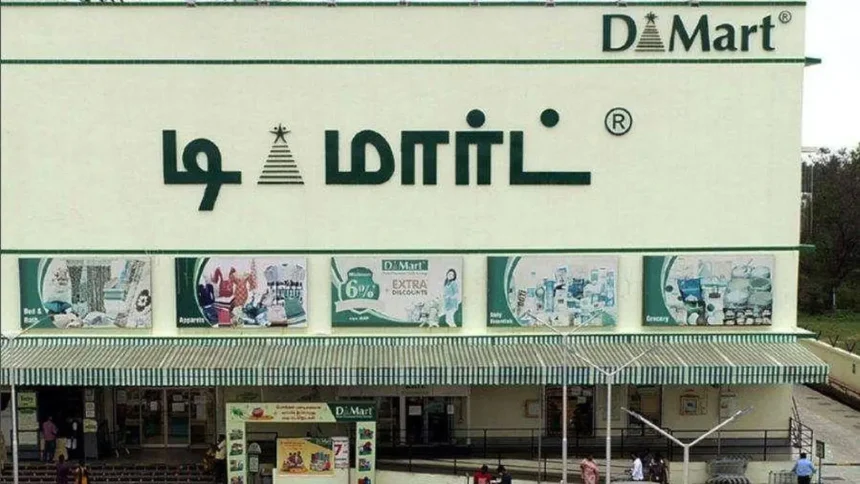
Avenue Supermarts, the company that operates the DMart supermarket chain, is opening stores faster than it is improving sales productivity. Its network expanded nearly 20 per cent to 518 stores from 432 over the past year, but annualised sales per square foot rose just 0.6 per cent, even as established outlets recorded their strongest like-for-like growth in three quarters.
The divergence is reflected in the company’s September-quarter results. Consolidated revenue rose 17.8 per cent year-on-year to ₹19,644 crore, while EBITDA grew 14.7 per cent to ₹1,393 crore and net profit attributable to shareholders increased 8.5 per cent to ₹743.57 crore. Sequentially, revenue increased 4.5 per cent, while EBITDA declined 7.1 per cent and profit fell 13.6 per cent.
DMart’s retail business area expanded 19.6 per cent to 21.4 million square feet from 17.9 million a year earlier. Yet annualised sales per square foot edged up to ₹8,741 from ₹8,692, according to its investor presentation.
Like-for-like sales growth at stores operating for at least 24 months accelerated to 9.5 per cent from 5.5 per cent in the June quarter and 6.8 per cent a year earlier.
Anshul Asawa, Managing Director and CEO of Avenue Supermarts, said, “Two years and older DMart stores grew by 9.5 per cent during Q2 FY27 as compared to 6.8 per cent in Q2 FY26.”
Customer bills increased 14.4 per cent year-on-year to 11.1 crore from 9.7 crore. The retailer added 15 stores during the quarter and 18 in the first half, following 85 additions in FY26.
The productivity measures cover different store bases. Like-for-like growth tracks established outlets, while sales per square foot reflects the wider network using quarter-end retail area. The contrast raises questions about how quickly newer stores mature, although their individual contribution is not disclosed.
Consolidated EBITDA margin narrowed to 7.1 per cent from 7.3 per cent a year earlier and 8 per cent in the June quarter. Despite generating approximately ₹849 crore in additional sequential revenue, EBITDA declined ₹106 crore and shareholders’ profit fell ₹117 crore.
“We remain committed to offering best value to our customers. Our pricing proposition thus remains strong in an inflationary environment. Wage inflation at entry-level has led to a marginal increase in operating expenses,” Asawa said.
Inventory holding periods increased to 36.1 days in H1 FY27 from 33.9 days a year earlier, while supplier payable days remained unchanged at 6.8.
Standalone inventory rose nearly 25 per cent to ₹7,018 crore at the end of September from ₹5,630 crore in March. Statutory operating cash flow declined 57 per cent year-on-year to ₹599 crore during the first half, despite higher earnings.
Total debt, including lease liabilities, increased nearly 80 per cent to ₹4,079 crore from ₹2,267 crore at March-end, with the debt-to-equity ratio rising to 0.15 from 0.09.
DMart Ready’s e-commerce footprint contracted from 19 cities in H1 FY26 to 11 in H1 FY27.
“We are focused on driving greater operational efficiencies and strengthening overall customer experience in the cities that we currently operate in,” said Vikram Dasu, Whole Time Director and CEO of Avenue E-Commerce.
For DMart, the challenge is converting stronger demand at established stores and rapid network expansion into higher productivity, improved margins and stronger cash generation.
Published on October 11, 2026