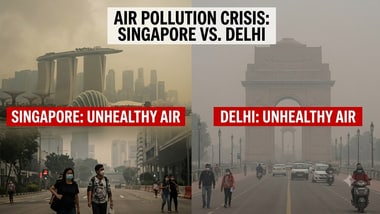
Singapore’s air quality deteriorated to an Air Quality Index (AQI) of 287, classified as unhealthy on a, as smoke from Indonesian wildfires intensified across Southeast Asia. The reading showed PM2.5 concentrations of 116 micrograms per cubic metre and PM10 levels of 164 micrograms per cubic metre. Delhi, meanwhile, recorded an AQI of 165 at 9 am on Thursday, placing it in the moderate category, according to India’s Central Pollution Control Board (CPCB).
The worsening haze has raised concerns about the health effects of fine-particle pollution across the region. East Timor has also suspended in-person classes for three days in response to pollution from wildfires in neighbouring areas.
reading on Thursday, 15 October. The air quality in India’s national capital was recorded in the ‘moderate’ category at 9 am, with an Air Quality Index (AQI) reading of 165, the Central Pollution Control Board (CPCB) data showed.
Under India’s CPCB classification, an AQI between 101 and 200 is moderate, while readings between 201 and 300 are considered poor.
Singapore’s live dashboard categorises its reading of 287 as unhealthy, reflecting differences in the terminology used by air-quality monitoring systems.
Singapore’s pollutant readings included carbon monoxide at 1,611 parts per billion (ppb), sulphur dioxide at 1 ppb, nitrogen dioxide at 2 ppb and ozone at 10 ppb.
PM2.5 refers to fine particles with a diameter of 2.5 micrometres or less. Because these particles can penetrate deep into the lungs, prolonged exposure can pose health risks. PM10 includes larger airborne particles, which can also affect the respiratory system.
The two cities’ readings were recorded at different times and may follow different reporting systems. They therefore provide a snapshot of their respective pollution levels rather than a direct, simultaneous comparison.
comes as Indonesia experiences its most intense wildfire season in 11 years. Dry weather conditions linked to El Niño have contributed to the fires, worsening air quality across the region and raising concerns about respiratory illnesses.
East Timor announced a three-day suspension of face-to-face learning beginning Thursday, citing pollution from wildfires in neighbouring regions or countries. Although its government did not name Indonesia, East Timor shares an island with Indonesia’s East Nusa Tenggara province, where multiple fire hotspots have been reported.
The regional impact of the haze has renewed concerns about transboundary air pollution, in which smoke from fires crosses national borders and affects neighbouring countries.
Indonesian President Prabowo Subianto has ordered additional resources to tackle the wildfires. Honi Havana, an official at the Coordinating Ministry for Political and Security Affairs, said the government was expanding its response.
“We are mobilizing all our resources and capabilities,” Havana said at a news briefing on Wednesday.
He said more than 69,000 firefighting personnel had been deployed, compared with around 44,000 in mid-September. Authorities are also testing specialised chemicals to improve firefighting operations.
Delhi has introduced a permanent Winter Pollution Master Plan, with restrictions scheduled for the winter of 2026-27. The measures include a ‘No PUCC, No Fuel’ rule, under which vehicles without a valid Pollution Under Control Certificate will be denied fuel.
From November 1, 2026, to January 31, 2027, petrol and diesel vehicles registered outside Delhi that do not meet BS-VI emission standards will also be barred from entering the city, subject to specified exemptions.
The plan also calls for 50% work-from-home arrangements in government and private offices, staggered office timings and double parking charges at authorised municipal sites, with Delhi Metro parking facilities exempt.
Dust-generating construction and demolition activities will face restrictions from November, followed by a reported blanket ban from December 10, 2026, to January 20, 2027. The permanent framework is intended to make winter pollution controls an annual measure rather than a series of ad hoc orders.