


A new study found that microbes from Earth might survive the harsh surface of the lunar south pole, albeit in a state of suspended animation. The findings reportedly suggested that lunar polar regions may “be less hostile to microbial survival than previously assumed.”
“Some of Earth’s microbes likely to hitch a ride to space with human explorers could survive in the shaded nooks and crannies of the region,” NASA scientists said.
The study titled, ‘Potential survivable niches for microbial life on the lunar south pole’, claimed to show that recent microorganism survivability data and lunar surface remote sensing reveal “likely survivable niches in lunar polar regions.”
Previous research suggested the surface of the moon was too harsh for microbes to survive. Specifically, a 2019 study found ultraviolet rays and heat from the sun are the greatest barriers for microbial life on the lunar surface.
“High ultraviolet radiation, temperatures, and energetic particle radiation limit survival over most unprotected lunar surfaces, particularly in equatorial regions where all previous crewed exploration occurred,” the study said.
However, it noted that whether these harsh conditions are widespread at the lunar poles has not been examined, given topographical effects. This means that the prior work did not account for the shelter that hills and valleys might supply on the moon.
These could prove especially significant at the lunar poles, where the sun never climbs high in the sky, leading to permanently shadowed regions that can host ice — and perhaps more.
“… topography plays a significant role in local conditions relevant to microbial survival,” given the context of the evolving understanding of the survival of microbes exposed to space environments, the article read.
According to the study, an analysis of topography and latitude-driven surface conditions using remote sensing data and high-resolution illumination models indicates the lunar south pole has substantial regions with “persistent low temperatures and ultraviolet flux.”
“Comparing these conditions to survivability data of specific microorganisms, we find that significant areas likely have surface conditions amenable to microbial survival. Our findings suggest that lunar polar regions may be less hostile to microbial survival than previously assumed,” it revealed.
It, however, added that the findings “do not encompass growth likelihood,” but survival in a “cryptobiotic state where growth would be possible if habitable conditions were present.”
This suggested that survival in this study means the microbe can stay alive for at least one Earth day, which does not mean that it can grow and reproduce.
Besides, Space.com explained that in the new study, researchers analysed three kinds of bacteria and two kinds of fungus.
These are all commonly found on crewed space missions, and include microorganisms that previous research discovered were especially durable in the harsh conditions of space.
Prior work found these lifeforms are resistant to vacuum, cold and high-energy particles.
The scientists compared previously compiled survivability data of these microbes with lunar maps that captured ultraviolet and heat readings on the moon’s surface.
They found that both lunar poles likely have areas where microbes could survive, albeit in a state of suspended animation known as cryptobiosis in which they could not move or grow unless more hospitable conditions appeared.
Microbes might not need much in the way of shelter on the moon. “Even a bootprint or a rover’s tread may create a habitable area,” study co-author Prabal Saxena, a planetary scientist at in Greenbelt, Maryland, told Space.com.
Five common microorganisms found on Earth could survive at the lunar south pole, the new study found, presenting a contamination risk for future human missions.
According to reports, scientists considered the possibility that missions to the moon might introduce microorganisms there.
NASA explains that bringing microbes along is unavoidable: “Humans have, on average, 1 million bacteria living on each patch of skin the size of a pencil eraser, for example. These bacteria vent from spacesuits and habitats.”
Though this paper’s authors worry about contamination interfering with the search for chemical clues to ancient geology or biology, they also argue that the Moon should be used as a natural lab.
Study co-author Heather Graham was quoted as saying, “Our findings show that we need to be even more thoughtful about the materials that we might unintentionally take with us when we are exploring space, and the impacts that we might have.”
Notably, the US and its space agency, NASA, plan to build a base on the moon. As humans move to build a permanent presence on the Moon, “it may become difficult to distinguish ancient lunar chemistry from contamination delivered by visiting astronauts.”
The concern extends beyond the Moon and on to Mars, scientists say.
“We need to understand what was there before us, because when we go to Mars to search for signs of life beyond our planet, we will want to make sure it’s not stuff we brought,” said Andrew Needham, a NASA Goddard-based paper co-author who is an Artemis contamination‑control scientist for lunar samples.
Scientists further believed it might be possible that ancient cosmic impacts might have blasted rocks bearing microbes off Earth that could have landed on the moon.
“The moon might be like Earth’s freezer, preserving really interesting bits of evidence of Earth’s past if they landed at the moon’s poles,” Saxena said.
Future experiments may test just how well microbes of many kinds might survive on the moon. Saxena told Space.com. “We have this great opportunity to really think about the limits of life and how resilient it is even in incredibly extreme environments.”
All in all, “the moon is a really diverse and interesting body, and the lunar poles are really unique regions in terms of how they can trap volatiles like water, and the ability to trap life,” Saxena said.
A clearer picture of where microbes might survive comes from understanding how sunlight behaves at the poles.
The lunar south pole has unique properties relative to the rest of the Moon, some of which enable the presence of surface/near-surface water ice, which fuels the heightened interest in the region.
Low Sun elevation angles at the lunar south pole due to the Moon’s orbit and obliquity and regional topography result in portions of the surface that receive significantly attenuated amounts of solar radiation.
These factors are what enables the presence and stability of water ice (3–5) and generally lead to low amounts of ultraviolet (UV) light, low temperatures, and low energetic particle flux in regions at the south pole relative to the rest of the Moon.
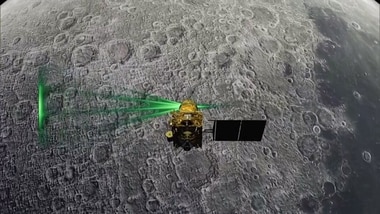
RADOM results from Chandrayaan-1 were used by the scientists to characterise the lunar radiation environment to evaluate its threat to microbial life. They cited the paper – “An overview of RADOM results for earth and moon radiation environment on Chandrayaan-1 satellite” — as one of its data sources.
Researchers used RADOM (Radiation Dose Monitor) results from the Chandrayaan-1 satellite, alongside data from the Lunar Reconnaissance Orbiter’s (LRO) CRaTER instrument, to assess galactic cosmic ray (GCR) fluxes near the Moon.
The study read, “GCR fluxes are even lower than these solar-sourced energetic particle flux radiation dosages—based on the most recent in situ measurements from LRO CRaTER (97) and RADOM results on Chandrayaan 1 (98) [convolving fluxes with particle cross sections gives destruction timescales of more than 1 million years].”
The Radiation Monitor (RADOM) payload is a miniature dosimeter-spectrometer onboard Chandrayaan-1 mission for monitoring the local radiation environment in near-Earth space and in lunar space.
RADOM measured the total absorbed dose and spectrum of the deposited energy from high energy particles in near-Earth space, en-route and in lunar orbit.
RADOM was the first experiment to be switched on soon after the launch of Chandrayaan-1 and was operational till the end of the mission.