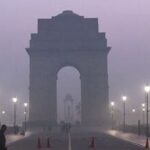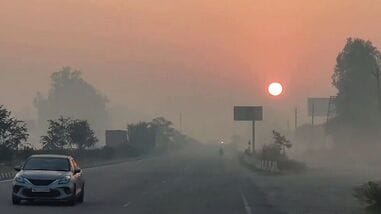
Panchgaon in Haryana, located about 30 km southwest of Gurugram, recorded the highest pollution level with an air quality index (AQI) of 390, placing it in the ‘very poor’ category, while Delhi registered an AQI of 321 at 7.05 am on Thursday, making the capital the 10th most polluted city.
Charkhi Dadri in Haryana followed with an AQI of 362, while Panipat and Bahadurgarh recorded 357 and 354, respectively, according to the SAMEER app developed by the Central Pollution Control Board (CPCB) in India. Bhiwadi in Rajasthan reported an AQI of 350, followed by Sitamarhi in Bihar at 349 and Manesar in Gurugram district at 342. Gopalganj in Bihar recorded an AQI of 331, while Sirsa stood at 324.
Several localities in Delhi recorded levels above 350, indicating very poor to severe air quality. They included Aya Nagar (363), Burari crossing (379), Chhhawla (368), Chandni Chowk (387), Commonwealth Sports Complex (352), Central Road Research Institute on Mathura Road (365), Delhi Technical University (374), Indian Institute of Technology Delhi (414), ITO (397), Jawaharlal Nehru University (378), National Institute of Homoeopathy in Narela (364), Delhi University north campus (394), Netaji Subhas University of Technology (NSUT) in Dwarka (383), NSUT in Jaffarpur (399), Punjabi Bagh (371) and Talkatora Garden (362).
The concentration of highly polluted cities across Haryana, Rajasthan and Delhi has renewed concerns over the region’s air quality. Experts have said there is a need for strict implementation of pollution control measures.
Stage 3 of the Graded Response Action Plan (GRAP), a framework of emergency measures taken to prevent deterioration of air quality in the National Capital Region, is currently active, alongside special vehicle and dust-control rules. Under GRAP Stage 3, imposed on Friday, there is a ban on light motor vehicles with old emission ratings (BS-III petrol and BS-IV diesel or below) plying in Delhi and the districts of Gurugram, Faridabad, Sonipat, Ghaziabad and Gautam Buddha Nagar.
There is also a ban on dust-generating construction and demolition activities in the NCR. Old commercial diesel vehicles registered in Delhi are barred from plying, alongside a complete entry ban into the capital for similar medium and light goods vehicles registered outside Delhi.
According to CPCB’s classification, an AQI of 0-50 is considered good, indicating minimal health impact. A reading of 51-100 is classified as satisfactory, while an AQI of 101-200 falls in the moderate category. An AQI of 201-300 is categorized as poor and may cause breathing discomfort to people with prolonged exposure, particularly those with respiratory conditions.
The very poor category covers AQI readings of 301-400 and is associated with illness on prolonged exposure, even among healthy people. The highest category, severe, applies to AQI levels of 401-500. At these pollution levels, even healthy people may experience respiratory effects, while those with existing health conditions may face more serious problems.