



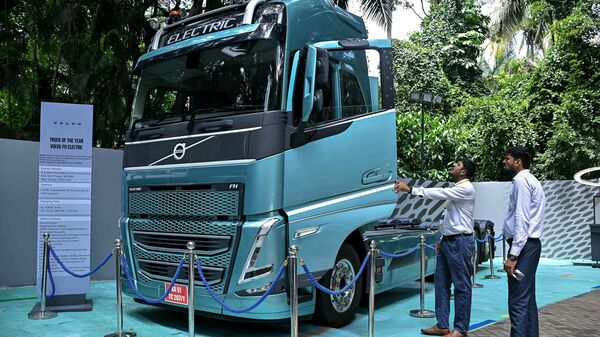
Chinese automakers Sany and Foton are pouring electric heavy trucks into India as established local manufacturers like Tata Motors and Ashok Leyland lag behind, raising concerns that low import tariffs are giving foreign firms an easy route into the local market.
Changsha, Hunan-based Sany, which also manufactures industrial and construction equipment, sold 722 electric truck tractors in India in FY27, compared with five in the same period last year, data from the government’s Vahan portal showed. Foton’s sales rose thanks to its partnership with Indian firm Energy in Motion (EIM), with sales reaching 146 units in the first five months of FY27, against none in the same period last year. EIM had gained access to import, assemble and sell Foton trucks last year.
The jump in sales has made Sany the largest heavy electric truck seller in the Indian market, ahead of number two Montra Electric, which sold 310 electric trucks in the first five months of FY27. Energy in Motion ranks third, ahead of Tata Motors, Eka Mobility and Ashok Leyland.
Queries emailed to Ashok Leyland, Tata Motors, Eka Mobility and Sany remained unanswered.
The fast growth in sales of these Chinese truckmakers has alarmed Indian executives, who argue that there is a need to eliminate the duty advantage enjoyed by these truckmakers, which can sell cheaper without building local manufacturing or R&D presence. This comes as infrastructure companies ramp up electrification of their own supply chains, with Birla Group’s Ultratech announcing on Wednesday that it will procure 600 EVs from Indian and Chinese truckmakers for its operations.
“It takes at least five years of work on research and development, and setting up manufacturing facilities to make these trucks. Local industry will need some level of protection,” a senior executive at a commercial vehicle manufacturer said on the condition of anonymity.
Narendra Murkumbi, managing director at EIM, said the cost differential between and diesel trucks was too high for Indian transporters, creating a hurdle in adoption of this technology.
“We have managed to disrupt the sector which has seen lack of innovation to cut down costs. Along with Foton trucks, we have also invested in a high-capacity charging and battery swapping network, which has helped us drive down costs and lead electrification in the heavy truck segment,” he said.
The matter gathered attention when Tata Motors managing director and chief executive Girish Wagh highlighted the duty concerns last month. Notably, Sany sold 605 out of 722 trucks in August, at a time when clamour over these import duty structures picked up pace.
“There is one anomaly today in the duty structure wherein the electric tractors, they seem to have been missed from the duty structure, and therefore, they enjoy a very low import duty of 10% today,” Wagh said at the company’s its post-earnings conference last month.
“This is something which has been brought to the notice of the government and we are very thankful that ministry of heavy industries has already picked it up and also requested the ministry of finance further to correct this anomaly,” he said. These vehicles are typically in the 55-tonne heavy truck segment.
EIM estimates that the electric heavy it brings are at least ₹30 lakh cheaper than similar offerings from Indian companies due to its battery as a service (BaaS) package.
Murkumbi of EIM said the company is already gearing up for local assembly, which will further drive down costs and it will not rely on fully-built unit imports.
EIM inked a deal with Foton in May 2025 to locally assemble and sell its electric heavy commercial vehicles in India. Sany India is a unit of Chinese Sany Group with primary operations in construction and mining equipment. It started scaling up its electric heavy truck business last year as a bid to enter the new-age market.
Of 132,000 heavy commercial vehicles sold in FY27, about 1,500 are electric, according to Vahan data, with EV penetration in its initial stages. Experts suggest that Indian companies will have to figure out ways to be competitive, which will allow them to compete with foreign firms.
“Chinese players still have an edge because they control so much of the value chain, from mining and refining critical minerals to cell production and permanent magnets, built over more than a decade of sustained investment. That gap will not close quickly. Indian firms need technology joint ventures, investment in refining and processing capacity, not just mining rights, and a realistic acceptance that import dependence continues for several more years even as that capability is built,” said Ravindra Patki, managing partner at Vector Consulting Group.