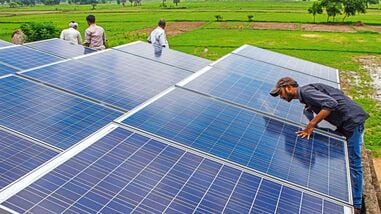
New Delhi: Centre plans to support installation of agrivoltaic capacity in the country under the second phase of Pradhan Mantri Kisan Urja Suraksha evam Utthaan Mahabhiyaan (), the flagship scheme to solarize irrigation, said Santosh Kumar Sarangi, secretary, union ministry of new and renewable energy.
Agrivoltaics, also known as agrisolar, is the practice of using a piece of land for both agricultural production and solar power generation. Addressing reporters on the sidelines of the AgriVoltaics World Conference 2026, said that the government plans to add about 5 GW of agrivoltaic capacity in about three years.
“It will be part of the PM KUSUM 2.0. The current Component A may be replaced with this (agrivoltaics). The additional cost of setting up agrivoltaic is around 25%. So the effort would be to neutralize that cost so that the tariff is equal to ground-mounted solar,” the secretary said.
Under the ongoing scheme, under Component A, the government supports setting up of small solar power plants with up to 2 MW capacity. The target is to set up 10 GW of cumulative capacity through these plants.
Mint earlier reported that the union cabinet is expected to consider a proposal worth around ₹51,000 crore to extend the scheme, with the government proposing a shift towards feeder-level solarisation and battery storage as it seeks to reduce agriculture’s dependence on conventional grid power.
The proposal includes about ₹35,000 crore for new projects and ₹16,000 crore to meet existing liabilities.
Addressing the seventh edition of the global conference, union minister for new and renewable energy Pralhad Joshi said the policy is aimed at increasing farmers’ income as agrivoltaics allows combining agricultural cultivation and generation on the same areas.
Estimates suggest around 30% of India’s 160 million hectares of cropland is suitable for installation of agrivoltaic projects, the minister said noting that agrivoltaics has started in many parts of the world as it also solves the issues related to land availability.
Stating that about four acres of land is required to install 1 MW of solar capacity, the minister said that 85% of total farmers in India are small and marginal, who can’t spare land by stopping agricultural activity.
Maharashtra, Rajasthan, Andhra Pradesh, Madhya Pradesh, Karnataka, and Uttar Pradesh together account for nearly half of India’s estimated agrivoltaic potential, he said.
Noting that the global agrivoltaic market has surpassed 18.4 gigawatt of the installed capacity, he said that India can also learn from the international experience. The government on Wednesday also released the draft policy measures to support agrivoltaics.
Addressing the inaugural session of the conference, German Ambassador to India and Bhutan Jasper Wieck assured support for joint research on pilot agrivoltaic sites. “Here we will test how agriculture and solar power generation can be combined economically and sustainably on the same land,” he said.