



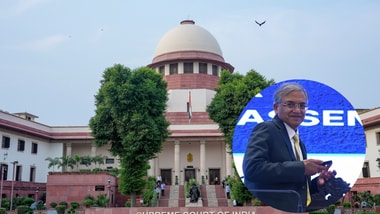
The Supreme Court orally observed earlier this week that the extent of legal protection India’s Chief Election Commissioner and the other election commissioners get under Section 16 of the 2023 Act is greater that what is accorded to judges of constitutional courts.
The comment was made during a hearing on petitions filed against the alleged unilateral decisions taken by CEC in relation to the Special Intensive Revision (SIR) of electoral rolls, .
The comments come at a time when the youth-led Cockroach Janta Party and other Opposition parties are alleging malpractice by the CEC. A protest was planned in this regard at Delhi’s Jantar Mantar on Saturday, but a number of top CJP leaders were detained by the Delhi Police before they could reach Jantar Mantar, the venue of the stir.
Appearing for the petitioner, Senior Advocate Vikas Singh said that the law in question, namely the Chief Election Commissioner and Other Election Commissioners (Appointment, Conditions of Service and Term of Office) Act, 2023, have substantial enhancements to the authority as well as immunity of the election commissioners.
The matter was being heard by a bench led by Chief Justice of India Surya Kant, where Justice Joymalya Bagchi and Justice V Mohana were also present.
Section 16 of the 2023 Act, CEC and Election Commissioners states that the CEC and the other election commissioners have protection from both civil and criminal proceedings in connection to the acts they performed while discharging or purportedly discharging their official functions. This protection even continues after they have demitted office.
Regarding the extent of the protection, Justice Bagchi said, “This protection is perhaps only for the President. It does not apply even to judges,” as per Live Law.
“Even the Prime Minister does not have this,” Singh submitted while arguing that this is an extraordinary legal protection.
He also said that this framework places the chief election commissioner “”on a pedestal even higher than Supreme Court judges.”
“ECI more powerful today than any other constitutional authority,” he added.
A notice has been issued by the Supreme Court to the central government, the ECI, the CEC, ECs.
A similar protection has been giving to Supreme Court and High Court judges in the The Judges (Protection) Act 1985, which states in Section 3(1), “no Court shall entertain or continue any civil or criminal proceeding against any person who is or was a Judge for any act, thing or word committed, done or spoken by him when, or in the course of, acting or purporting to act in the discharge of his official or judicial duty or function.”
Notably Section 3(2) of the Act states, “the power of the Central Government or the State Government or the Supreme Court of India or any High Court or any other authority under any law for the time being in force to take such action (whether by way of civil, criminal, or departmental proceedings or otherwise) against any person who is or was a Judge.”
This provision is not present in the CEC Act.