


India has rejected concerns raised by the United Nations Human Rights office over reported detentions during demonstrations in New Delhi, describing the remarks as “misplaced” and an “unwarranted interference” in the country’s internal affairs. The protests were linked to demands by Cockroach Janta Party (CJP) and others for the resignation of Chief Election Commissioner Gyanesh Kumar amid concerns over the Special Intensive Revision (SIR) of electoral rolls.
In a response issued by the right to peaceful assembly was guaranteed by the Constitution and protected by the country’s democratic institutions, independent judiciary and free media.
The response came after the expressed concern over reports of detentions involving demonstrators, leaders, civil society members, lawyers and journalists before and during the Delhi demonstrations.
India also urged the UN Human Rights office to devote comparable attention to large-scale protests in other parts of the world, citing the need for impartiality and non-selectivity in its work.
In its response, India said peaceful assembly was a constitutional right, but noted that its exercise was subject to reasonable restrictions in the interest of public order.
“India is the world’s largest democracy, where the right to peaceful assembly is guaranteed by our Constitution and safeguarded by robust institutions, an independent judiciary and a free media,” the Indian mission said.
It added that authorities acted in accordance with the law and that courts remained accessible to citizens seeking redressal of grievances.
“The OHCHR’s concerns are therefore misplaced and constitute an unwarranted interference in the internal affairs of India,” the statement said.
India also questioned what it described as the UN office’s approach to protests across different countries.
“In this context, OHCHR would also do well to devote comparable attention to large-scale protests elsewhere, consistent with its mandate of impartiality and non-selectivity,” the mission added.
The linked to the protests in Delhi.
“We are concerned by reports of mass detentions in India of demonstrators, protest leaders, members of civil society organisations, lawyers and journalists, before and during today’s large-scale demonstrations in Delhi,” the OHCHR said.
The UN office called on Indian authorities to ensure that the right to peaceful assembly was fully respected and upheld.
The office also called for the immediate and unconditional release of anyone arbitrarily detained.
“All those arbitrarily detained must be immediately and unconditionally released,” the statement said.
The UN Human Rights office further urged the authorities to engage in meaningful dialogue to address the concerns raised by protesters.
The exchange comes amid heightened tensions surrounding large-scale demonstrations in the national capital. The protests were linked to demands for the resignation of Chief Election Commissioner Gyanesh Kumar amid concerns over the Special Intensive Revision (SIR) of electoral rolls.
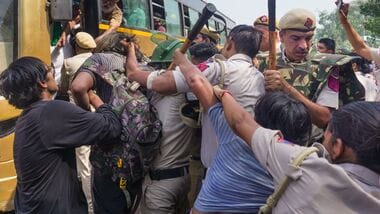
Over 7,000 protesters, including Cockroach Janta Party (CJP) leader Abhijit Dipke, several opposition leaders, activists and YouTuber Dhruv Rathee, were detained across Delhi on Saturday as authorities thwarted a planned mass mobilisation at Jantar Mantar demanding the resignation of Chief Election Commissioner Gyanesh Kumar.
The security deployment, involving more than 30,000 police and paramilitary personnel, left the designated protest site largely deserted. Multiple layers of barricades, restrictions on movement and the closure of 45 metro stations disrupted movement across parts of the national capital.
The protest was organised by the CJP amid controversy over the Special Intensive Revision (SIR) of electoral rolls. Opposition parties criticised the detentions, with Congress leader Rahul Gandhi urging young people to continue protesting and accusing the government of attacking the Constitution.
The scale of the detentions remained contested in initial police accounts. Delhi Police sources had earlier said around 1,000 protesters had been detained while attempting to march towards Jantar Mantar.
Barricades were erected across Lutyens’ Delhi, while intensive checks were carried out at border points, railway stations, bus terminals, hotels and other sensitive locations.
Authorities also monitored social media platforms for attempts to mobilise protesters. More than 200 content creators were reportedly under scrutiny as police examined online posts and messages linked to the proposed gathering.
CJP convener Abhijit Dipke and party leaders Saurav Das and Ashutosh Ranka were detained at Delhi airport upon their arrival from Mumbai, according to the account provided.
In a video shared by the CJP, Dipke was heard telling police officers who entered the aircraft: “We are here to be arrested, come and arrest us.”
Before detaining the CJP leaders, police personnel told them that they did not have permission to hold the protest at Jantar Mantar.
Dipke accused the authorities of treating party leaders like criminals and described the action as dictatorial.
YouTuber Dhruv Rathee, who lives abroad and had travelled to India to join the demonstration, was detained from his residence in Gurugram’s Sector 56 on Saturday.
Several opposition leaders were also detained at different locations across the capital, including former chief ministers Arvind Kejriwal of the Aam Aadmi Party, Mamata Banerjee of the Trinamool Congress, and Pinarayi Vijayan and Manik Sarkar, both associated with the CPI(M).
The detentions triggered sharp criticism from opposition leaders, who compared the government’s response to the Emergency.
Leader of the Opposition in the Lok Sabha Rahul Gandhi expressed solidarity with the protesting youth and urged them to continue their demonstrations.
He challenged Prime Minister Narendra Modi to arrest all protesters, asserting that they would continue their fight to defend the Constitution and protect the voice of the Indian people.
“We are going to ensure that this regime and the people who have attacked the Constitution are defeated,” Gandhi said, urging young people to “keep protesting”.
The opposition has argued that the detentions undermine democratic freedoms and the right to peaceful protest. The authorities, meanwhile, cited the lack of permission for the proposed gathering and maintained a heavy security presence across the city.
A senior police officer said multiple first information reports (FIRs) were likely to be registered in connection with the alleged assault on police personnel.
Regular announcements were made at Jantar Mantar, instructing members of the public and mediapersons not to gather in one place.
The clashes came amid extensive security checks and restrictions on movement across the national capital, with commuters advised to follow official announcements and plan their journeys accordingly.
Activist Sonam said he would consider launching a peaceful protest, including a hunger strike or a march in Leh or Delhi, if the detained protesters were not released within 24 hours.
Wangchuk had participated in an earlier 36-day CJP agitation at Jantar Mantar over the NEET paper leak issue, which ended on July 25 following the resignation of Union Education Minister Dharmendra Pradhan, according to the supplied account.
That agitation had also witnessed disruption during a march towards Parliament on July 20, when security personnel attempted to stop protesters.
Wangchuk’s latest warning adds to the pressure on the authorities to address the detentions and the demands raised by demonstrators.
The demonstrations and detentions extended beyond Delhi, with police detaining around 400 people in Mumbai during protests held in solidarity with the CJP’s proposed march.
Those detained reportedly included actor Imran Khan, activist Tushar Gandhi and CPI(M) workers.
The demonstrations took place at August Kranti Maidan, Hutatma Chowk and other locations across the city. Police detained participants on the grounds that the protests were being held without permission.
The immediate flashpoint remains the CJP’s demand for the resignation of Chief Election Commissioner Gyanesh Kumar amid concerns surrounding the Special Intensive Revision of electoral rolls.